REALITY: TIBETAN TAKES
This essay is about three civilisations: China, USA and Tibet. In these degenerate times Chinese and American leaders loudly proclaim their civilisational superiority, both racing to dominate the future, with rapidly evolving artificial intelligence at the forefront of their accelerationist campaigns.
Tibet seldom calls itself a civilisation, even though it is deeply committed to Tibetan culture and its ongoing transmission across generations. The last book called “Tibetan Civilisation” was published by a French scholar in 1962 in French, an English translation a decade later.[1]

There is a grandiosity associated with civilisation, abundantly trumpeted alike by Donald Trump and Xi Jinping, claiming special civilisational status, as pinnacles of human social evolution, to be emulated by all. There is no such grandiosity among the Tibetans.
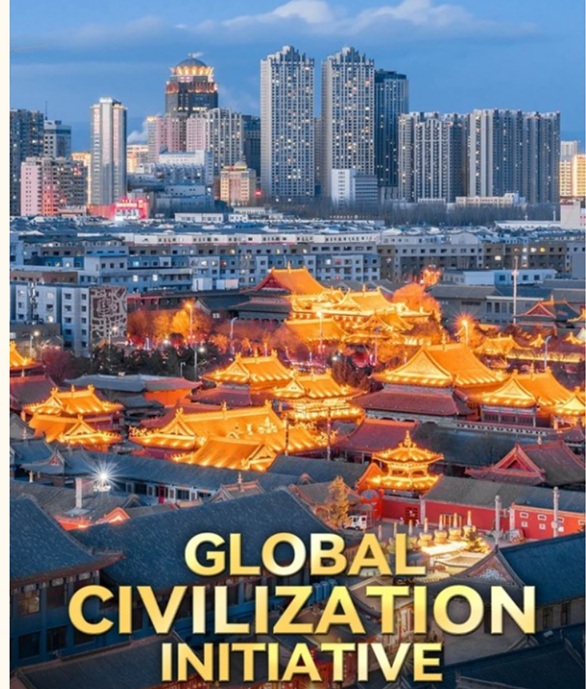
Rather than narrowly analysing whether China or US will win, a Tibetan perspective enables us to understand more clearly what AI accelerationism is about and its likely consequences. The reason for suggesting Tibet as a culture and a civilisation helps us to gaze afresh at the claims to greatness of the two great rivals, US and China, in this time of moving faster to win AI dominance. The philosophical commitments that make Tibet a civilisation triangulate the contending superpowers, revealing the assumptions they make about what it is to be human, to be embodied, why the prospect of transcending into cyborg transhumanism is so magnetising to governments, tech entrepreneurs and investors; why the rest of us are horrified.

The future is about to arrive, we are often told, both by American tech billionaires and China’s leaders, in which “anyone can have everything they want” to quote Elon Musk, because “the singularity has arrived”, to quote Sam Altman. On both sides of the Pacific the AI engineers insist on maximum speed, brushing aside regulators as doomers fixated on dangers. All that matters is winning mastery of the tech that displaces human labour, ushering in the age of abundance. For China, dominating AI is key to China dominating the 21st century; for America beating China is all that matters, and must not be slowed by laws and controls. Their rivalry gives each an excuse to heedlessly race, lest the other win.
Despite differences, China and USA are remarkably similar in their total embrace of materialist modernity, of capitalism as the engine of endless wealth accumulation; differing only as to whether billionaire tech bros dominate the state, or the state orchestrates capitalism. Usually we obsess about the differences and fail to notice their mutual commitment to cloud capitalism: “networked machines that produce no commodities but generate enormous rent-extractive powers, on behalf of their owners, through interfacing directly with us, outside anything that can be usefully described as a market. Studying this fascinatingly novel form of capital that has transformed capitalism into what I call technofeudalism. What AI brings is a massive escalation in cloud capital’s extractive powers and the final demise of any pretence that cloud fiefs compete in anything resembling a marketplace.
“An AI-powered version of Alexa, or a similar bot, will very soon not only know you perfectly but will be able to speak to you in a manner that is indistinguishable from that of a human. Meanwhile, underneath its human-like bonhomie, it will gradually cultivate in you a dependence that makes it indispensable to your psyche. Going back years, it will remember every detail of anything you said or did or wished for. It will develop a capacity to take you to the brink of your tolerance (so as to extract maximum rents from you, and the vendors selling to you) without crossing your red lines. It will have perfect recall of your whims, musical sensibilities, shopping habits, disappointments. It will keep you company in moments good and bad. Wall Street and monopoly capital has been overshadowed by the increasingly dominant cloudalist or technofeudal ruling class which is concentrating all powers in its owners’ hands (financial, industrial, political, cultural and state power). However, and this is its central dialectical contradiction, the more it succeeds in concentrating every power that matters in its hands, the more our new ruling class is undermining itself in the long run, unleashing as it does a dynamic heralding systemic collapse ”[2]
NO INNOCENT BYSTANDERS
The epic fury of China and US racing to dominate impacts the whole world. States seek to resist the pressure to take sides, US or China. China’s pitch to the Global South and to Europe is that unlike USA it is reliable, peaceable, never invades anybody, and makes its AI freely available for anyone to deploy. However, anyone means any state seeking to intensify its power over its own citizens. Senior China policy analyst Rush Doshi: “China is focussed on winning the technologies of the future. If the U.S. were to lose the competition over the next wave of industries—including A.I., biotech, and robotics—as it lost the ones over solar panels, batteries, and electric vehicles, it would irreversibly change the balance of power. What kind of world does China imagine? Autocracies are considered perfectly legitimate, and technology is used to strengthen them. China increasingly says to autocrats, Would you like to stay in power? I can help you with that.”
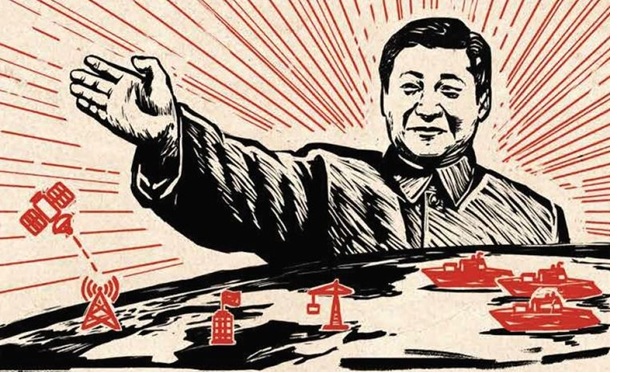
At the World AI Conference in Shanghai, mid 2026, Xi Jinping enticingly offered Chinese AI to the world. The one AI model actually on offer was the Fenghe Wind Harmony weather forecaster developed to enable China to govern Tibet remotely, trained on Tibet data. Tibet, the land closest to the sun, is now data crunched by AI, giving lowland China forewarning of what is coming their way through the rivers of the sky Although meteorological data monitoring of the skies above Tibet is quite recent, it is hard to persuade Chinese lowlander scientists to live in Tibet, so meteorology is done remotely, the data chewed by AI.
THROUGH TIBETAN EYES?
Introducing a Tibetan perspective reveals the implicit assumptions, atomistic reductions, wilful exclusions of nature, exiled as externalities, off the ledger, that afflict Chinese and American enthusiasms alike, and make AI so dangerous.
The commitments that make Tibet a civilisation, commitments consistently reaffirmed, revalorised, relived, refreshed over more than a millennium, give us a fresh perspective on the entire Anthropocene acceleration, in both its Chinese and American incarnations. That is the point of proposing Tibet as a civilisation.
Invoking a classic Tibetan gaze provides critical insight into the grandiose claims of AI, whether Chinese or American. This is in no way claiming privileged status for Tibet, elevating it to parity with the superpowers. Instead it is a turn to a deconstructive gaze that challenges endless growth as the abiding source of human happiness. A classic Tibetan gaze is a critique of unsustainable speed that exhausts planetary endowments in the quest to become transhuman prosthetic gods.
Much is made of the Dalai Lama’s commitment. A 2025 book elaborating those commitments names them: “Promotion of universal and basic compassionate values to create a happier and more a peaceful world based on the understanding that all of us are one and the same human beings. 2. Promotion of harmony among the world’s diverse religious traditions by emphasising the basic tenets of love, compassion, tolerance, and contentment present in all religious traditions. 3. Preserving the rich spiritual and cultural traditions of Tibet which has its roots in the Nalanda tradition of India, and conserving the fragile ecology of the Tibetan plateau that has a direct impact on the ecology of not just Asia but the entire world. 4. Reviving the wisdom and knowledge of ancient India such as the workings of the mind and emotions, and the practice of non-violence and compassion along with the development of modern education among the Indian youth.”[3]
ALL THAT IS SOLID MELTS INTO AIR
Underlying the Dalai Lama’s commitments is commitment to fully awaken to the nature of mind, and of phenomenal reality. That is the embodied source of all four commitments the Dalai Lama has consistently manifested throughout a long life. It is this unbroken lineage of training the mind that makes Tibet a civilisation with fresh insights into our rush to AI, the promise of endless abundance and transhuman colonisation of other worlds.
With very few exceptions Tibetans revere the Dalai Lama, seeing how he transformed loss and imminent obscurity into global awareness that Tibet has much to offer, that the material world needs. His labile laughter, his commitment to decades of dialogue with mind scientists, his many teachings on the nature of reality all reveal treasures that will resonate long after he bodily disappears.
His world making is an unmaking of the ideologies of the most powerful politicians, the tech bro billionaires, the utopian hopefuls pitching imminent godlike abundance. The Dalai Lama’s commitment to wholly, directly experiencing the nature of thoughts and ideas, as an alternative to getting caught up in their hallucinatory detail, provides freshness, immediacy, spaciousness, fluidity to a world enmeshed in solidity, competition, confusion, conflict.
“His Holiness talks a lot about mental hygiene, about a map of the mind, about how these afflictive emotions (kleshas or nyongmong) arise, and would say that this again doesn’t require any belief because it is all done through critical inquiry, reasoning and debate and understanding of what is valid cognition.”[4]
If we understand the gaze of the Dalai Lama, we make legible those who gaze on us, classify us as consumers, citizens, markets, objects requiring control and civilising. We reverse the gaze of the institutions that define us as their product, their source of profit, that rent our minds and bodily labour for the greater glory of the party-state or American Greatness.
That is why proposing Tibet as a civilisation is useful. Yet this proposal comes from someone who is not Chinese, not American, not Tibetan, a gross impertinence.
ENACTING COMMITMENTS
If Tibetan civilization is lost, the world loses. This Dalai Lama, -the Victorious One/Gyalwa Rinpoche as Tibetans usually call him- has been adept, in the few seconds we are able to concentrate, in showing us Tibetan culture offers an inner path to freedom, by realising the nature of all that exists, a subtle but profound realisation of interconnection, that can teach us that not all wants are needs, not all desires need trigger consumption. The precious victorious one reminds us all life is precious, this moment is precious, no need to wander aimlessly, repeating our mistakes. No doubt this old monk, born 1935, is precious, but how can we say he is victorious?

To this elderly environmental essayist, one specific victory stands out. In 2006 many Tibetan men proudly and competitively adorned their best ceremonial attire with tiger skins smuggled from India, otter skins from Canada, leopard skins from Tibet. Inside Tibet the lamas and khenpos who throughout Tibetan history reminded men not to be so vain and foolish had been silenced by official decrees banning them from public life. But this Dalai Lama, directly addressing Tibetans who had crossed the Himalayas for a once in a lifetime chance to be in his presence, and then return, gave his hearers an earful.
In the most direct and personal way, this Dalai Lama issued pithy instructions, heartfelt heart advice on how to live: “Tibetans should stop hunting wild animals. As soon as we give up wearing clothes trimmed with animal fur, there will be less violence against animals. In today’s world of booming population, negligence of the environment is tantamount to deliberate destruction of our own homes. Some insensitive Tibetans in Tibet wear outfits adorned with tiger, leopard and otter skins.
“Such behaviour, indeed, makes every one of us feel embarrassed. I am just an individual, which is not a big deal. However, Tibet’s responsibilities rest on my shoulders. Tibetans indulging in illegal activities at a time when I am getting old makes me feel as if it does not matter whether I remain alive or not. We are calling for a ban on killing wild animals. We also appeal to the people to invoke compassion for animals.”
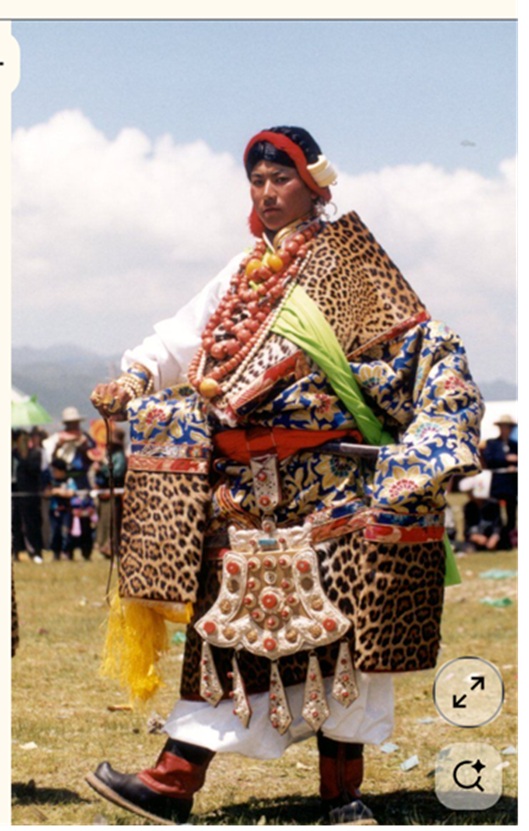
Tibetans were so shocked that within days bonfires were lit, burning furs for which billions had been paid by their wearers. The Dalai Lama had spoken as one human being, investing his whole reputation, jeopardising the whole trust the Tibetan people have in him. If the fur wearers ignored him, he would have been humiliated; he wasn’t afraid to put his authority on the line. He was victorious. It was such a victory the wildlife campaigners, such as Wildlife Trust of India, were amazed, calling this the most successful campaign they had ever initiated. The bond of trust the Tibetans have in their Dalai Lama, far from them in another land, was palpable, for all to see.
TIBET AS A CIVILISATION
Geshe Lhakdor, director of the Library of Tibetan Works and Archives: “Tibetan culture and civilization is extremely rich which is normally expounded under the category in the five or ten subjects of study (Rigne Nga and Rigne Chu) – the five major subjects of knowledge and the five minor subjects of knowledge. But these ten essentially include almost every facet of human knowledge and they all focus upon how to help others. The Chinese government these days claims that ‘before they came all our knowledge was restricted only in these so-called five and ten subjects’, there were many other subjects that we had to learn which were not available and that they introduced to us. China used to be a country of great civilization but now they are paying more attention to the material objects and completely ignoring the inner richness for external material accumulation. So in the case of Tibetan civilization and culture the inner jewel, the inner gem, the inner richness, the Tibetans have accumulated for so many centuries is something that the human beings, the human world can benefit very much.
“The western method of finding things is external, by going outside, exploring the atoms, exploring the other material objects, they came with this sophisticated science and technology which is good to some extent, provided they are used properly. But unfortunately if the user, the human being, the human mind is wild, is unruly, undisciplined, then all these powerful weapons, technologies will be used to oppress others, bully others which the Chinese government and many others are doing. It is very unfortunate. So therefore at the end of the day, for me I have this trust and believe that Tibetan culture really has a huge contribution to make to the rest of the world.”[5]
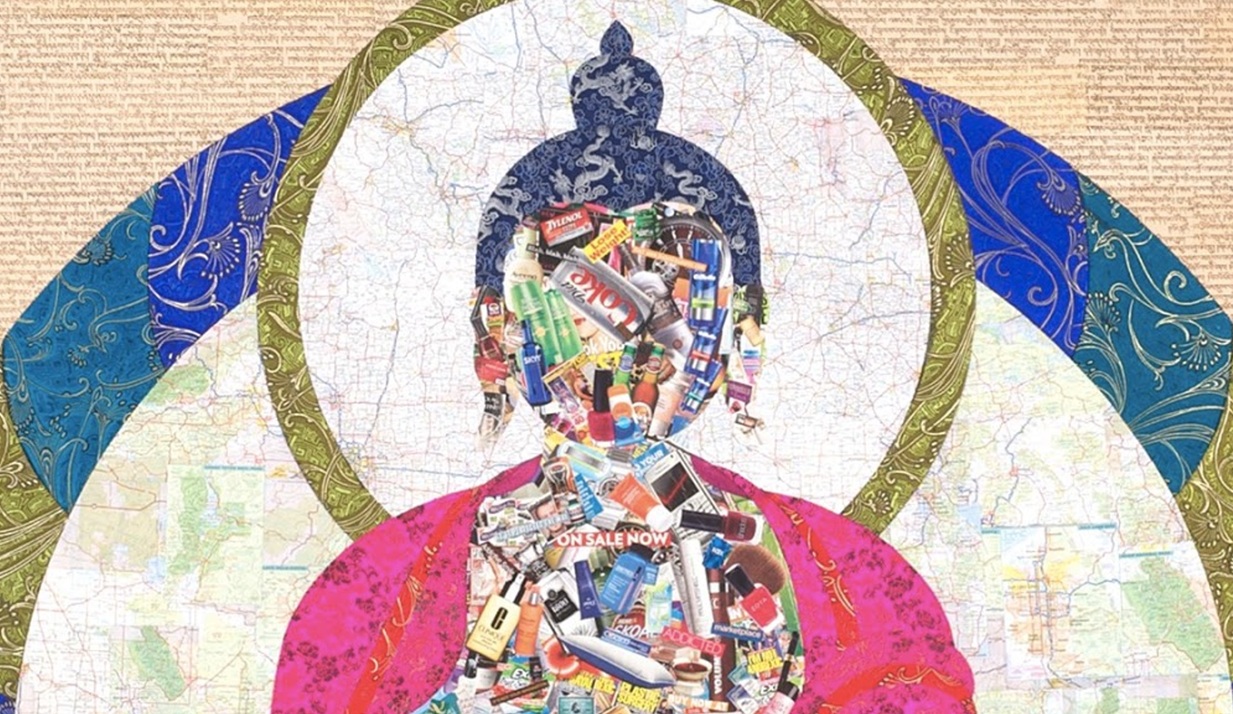
Not many Tibetans speak of civilisation, because it usually signifies grandiose pretensions, narratives of manifest destiny, divine providence, invincible superiority.
invoking civilisation invokes dominance, as in the US 2025 National Security Strategy, which warned that Europe allowing migrants to refresh Europe’s workforce would within a decade or so succumb to “civilizational erasure.”
Central to China’s messaging worldwide, core of compulsory school textbooks, is the claim that the central kingdom is not only the great civilisation, but has been so for 5000 unbroken years of continuity. This wilful oversimplification reduces the idea of China to caricature. “The idea of China has always been and remains a continuing process, invented, subverted, and reinvented to serve the shifting needs of kings and bureaucrats, industrialists and intellectuals, allies and adversaries.”[6] China’s laws and policies to establish nature reserves and protected areas is officially called the campaign to construct ecological civilisation.
WIN, WIN, WIN
Debate usually fixates on who is winning and why, on the clash of civilizations. The Americans are sure tech bro billionaires, financed by investors expecting to make massive profits if they pick the winner, will inevitably succeed because that is what capitalism does best. China’s central planners are equally confident that party-state top level design, orchestration, subsidies can further accelerate this quintessentially Anthropocene race. Both have plenty of evidence to support their competing strategies.
This obsession with winning leaves populations apprehensive. Utopia becomes dystopia? Millions of workers lose their jobs, replaced by AI and robots? In the race frame, this nightmare of descent into technofeudalism supposedly only afflicts Americans and Europeans, not Chinese.
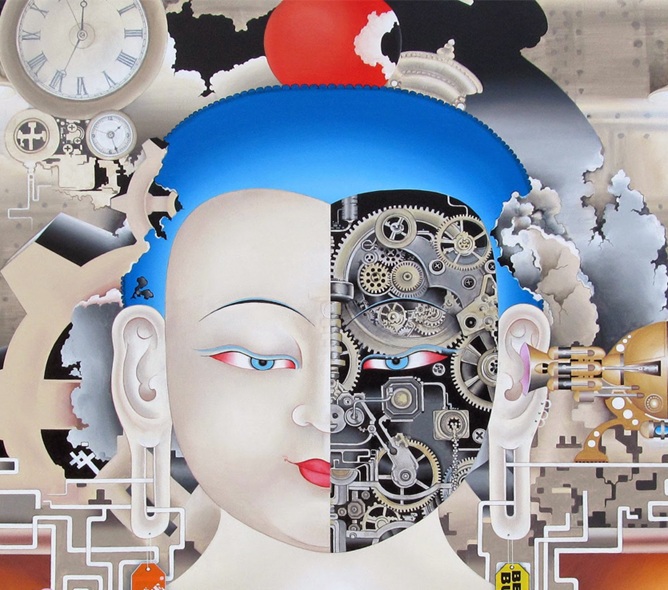

But Chinese pioneers of AI see it differently: “A growing pool of unemployed workers will compete for an ever-shrinking number of jobs, driving down wages. Wealth inequality will go from bad to worse, as AI algorithms destroy millions of human jobs, while at the same time turning the tech titans who harness these new technologies into billionaires in record time. Left unchecked, AI in the twenty-first century may bring about a new caste system, with a plutocratic AI elite at the top, followed by a relatively small subset of workers with complex jobs that involve wide-ranging skill sets and large amounts of strategy and planning, creatives (many of them low paid), and the largest contingent: the powerless struggling masses. Even more problematic than the loss of jobs will be the loss of meaning. The work ethic born out of the Industrial Revolution has instilled in many of us the idea that careers should be at the centre of how we derive meaning from our lives. In the coming years, people will watch algorithms and robots easily outmanoeuvre them at tasks they’ve spent a lifetime mastering. Young people who grew up dreaming of entering certain professions may have their hopes thwarted. This will lead to a crushing feeling of futility and obsolescence, paving the way for increased levels of substance abuse, depression, and suicide. Even worse, it will lead people to question their own worth and what it means to be human.”[7]
These are the predictions of a senior Chinese AI scientist who since 1990 has held key positions at Apple, Microsoft and Google before launching his own AI startup in China.
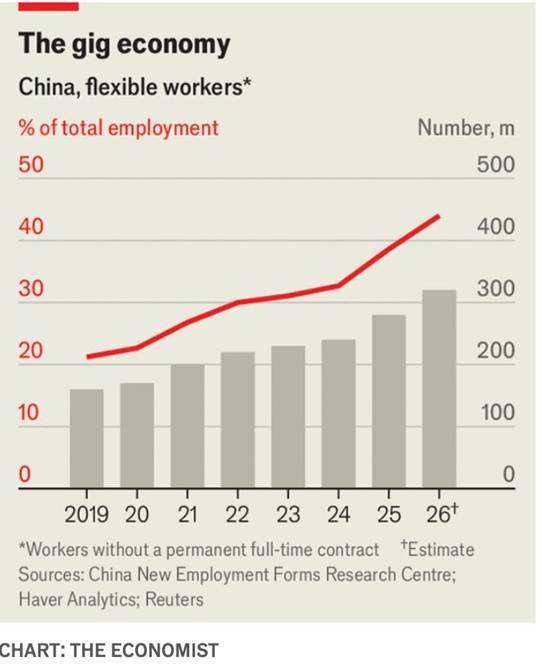
In China this emergent future deeply impacts Tibetan civilisation at a time of maximum assimilationist pressure to not only erase the Tibetan language but move Tibetans off their lands, into prefabricated villages and later into towns and cities, once they have been “civilised” to believe in the China dream of material prosperity. [8]Tibetan lands are being routinely depopulated by decree, shunting Tibetans onto the conveyor belt of modernity at a time when robots, AI, automation all destroy the entry level gig economy jobs Tibetans would have to take.
According to detailed policy prescriptions of current Five Year Plans, at national and provincial levels, Tibetans must be pressed to abandon Tibetan identity in order to climb the ladder of material success, at exactly the time AI removes the lower rungs of the ladder. This prospect is a further reason to take a fresh look, from a Tibetan perspective.
ENGINE OF MODERNITY
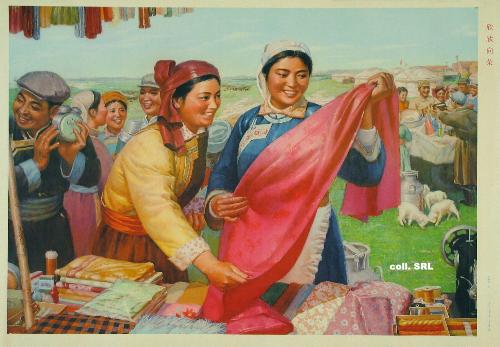
What Tibetans discern is China, in the name of progress, prosperity, modernity relies on generating desire, for wealth, status, competitiveness: a bigger house, a newer car, ostentatious displays of material success.[9] If desire, to consume more, display more, compete more is absent, the entire engine -of material accumulation as the purpose of life- fails to start.
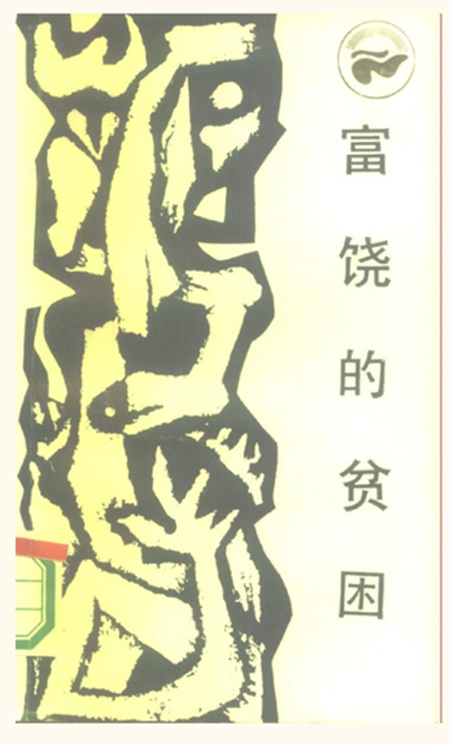
Back in the 1980s two leading Chinese economists sent to Tibet to investigate how to start the engine came away disheartened. Their report is part of the “Toward the Future” series, a highly influential Chinese intellectual book collection published in the 1980s, authored by economists Wang Xiaoqiang and Bai Nanfeng. In 1986 Wang and Bai, from the Economic Structural Reform Institute reported their experience of Tibet: “The people who live within the natural economy of the vast backward regions require neither commodities manufactured by modern industries nor the up-to-date culture and education brought in alongside these industries, but remain materially and spiritually content with their old way of life.”
This Tibetan lethargy contrasts with the economic vigour of the Cantonese: “Almost anything that flew, swam or crawled was fit for the pot in the eyes of the Cantonese. This enriched the extent of natural resource utilisation and at the same time resulted in highly stratified intensive exploitation which moreover brought about the continuing reorganisation of modern agriculture. In Tibet, on the other hand, even today, many years after the introduction of industrial civilisation, the indigenous people still neither eat vegetables or fish nor raise poultry… There is absolutely no demand for pots or pans, bowls or utensils, or any condiments such as oil, salt, soy sauce or vinegar… As long as the inhabitants of these regions cling to their self-sufficient ownership of livestock that are never sold, or to their wealth which consists in the consumption of a few hundred kilograms of yak butter every year, then it is apparent they can in no way appreciate production techniques designed for exchange. Thus, the transformation of the local way of life is a prerequisite for any change in modes of production.”[10]
To the despair of these leading economists, no key to initiating desire, craving, grasping could be found. This was a great challenge, taking several decades to overcome. This was shocking, because all across lowland China, entrepreneurial competition was booming. In the mid 80s across China capitalist enterprise, especially gètǐhù: 个体户small businesses were booming, farmers rapidly increased production, marketing and income.[11]
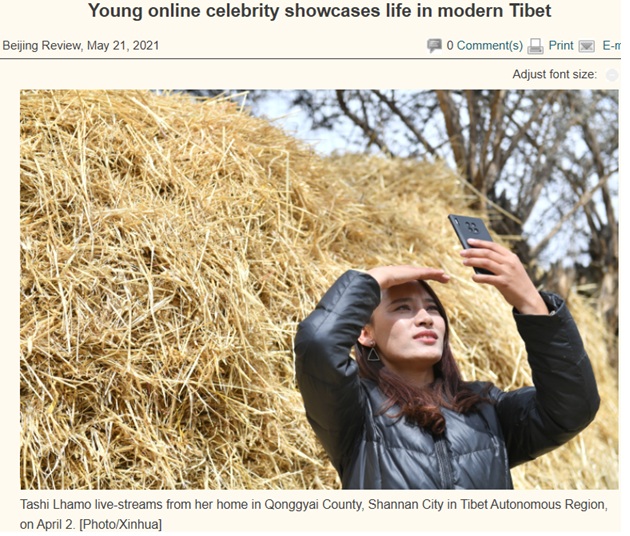
Now China has succeeded in instilling desire, embedded alike in Tibetan and Chinese minds. It took decades; it wasn’t easy. In recent years smart phones and social media influencers achieved much as vectors of craving; now AI is accelerating the trend further. Widespread Tibetan ownership of smart phones spread endless images of consumption luxuries instantly available. Covetousness kindled. Desire is now core curriculum in schools throughout Tibet, as core as instruction all in Chinese, a language with a big vocabulary of desire, production, consumption, competition as the drivers of all imaginable success. Official party-state discourse and popular Chinese slang are alike in promoting consumption as the purpose of life.


TOUGH
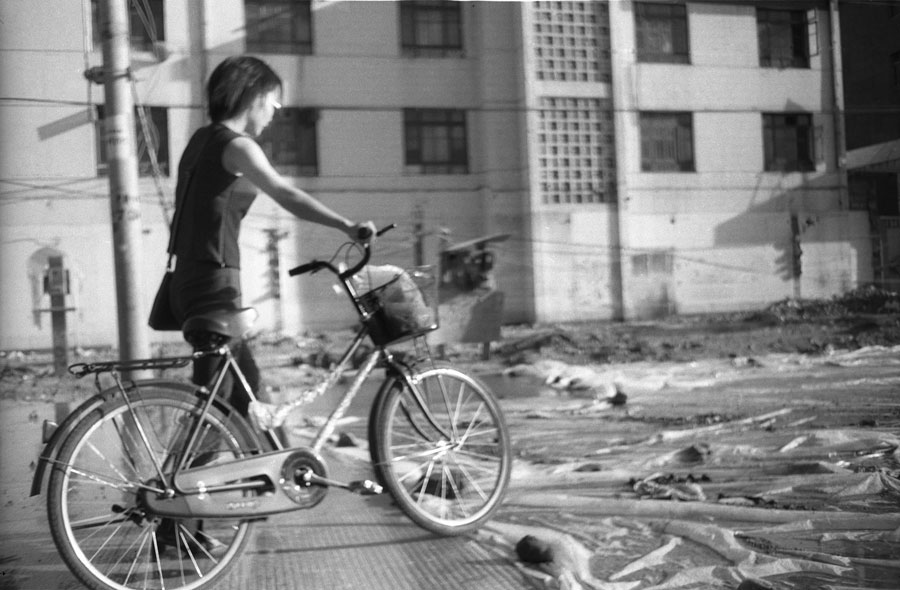
Tibetans now old enough to remember growing up in villages, before desire became life’s purpose, recall a life of hard work and few possessions, everyone happy, much mutual cooperation, whether building a house or taking the herds out to a new pasture. Now, they say, if one man builds a bigger house the neighbours are jealous, even angry, driven to compete and build bigger. Materially better off, mentally much more anxiety, grasping and discontent.
In 1975 Chogyam Trungpa, looking back on his precommunist childhood and adolescence in Tibet, said: “The Tibetan peasants were not all that aggravated or pissed off by their situation before the Communists; they were well off in their own way. They had lots of space for farming. Maybe they were hard up in terms of comfort and things like that, but our people are very tough. They can handle the hard winters; they appreciate the snow and the rain. They appreciate simple ways of traveling; they don’t need helicopters or motorcars to journey back and forth with. They are very strong and sturdy; they have huge lungs in order to breathe at a high altitude. We’re tough people! The peasants took pride in those things, obviously. Their faith and their security and their pride was based on some kind of trust in the teachings and in the church, which was slightly crumbling but which still remained.”
Cultivating discontent drives China’s enormous machine of modernity, the endless quest for more. Craving more is a worldwide aspiration, in China systematised, infused into every level. The trucks carrying displaced villages off to compulsory new frontier villages are festooned with big red and gold banners announcing the convoy is (compulsorily) en route to compulsory prosperity. The displaced are spoken for by the big propaganda slogans draped over their transit to a new life, where all old skills are cancelled.
On arrival in a new prefab frontier village the displaced are handed giant keys, posing for the official cameras in their best Tibetan clothing, smiling compulsorily at being given keys to the promised prosperity.
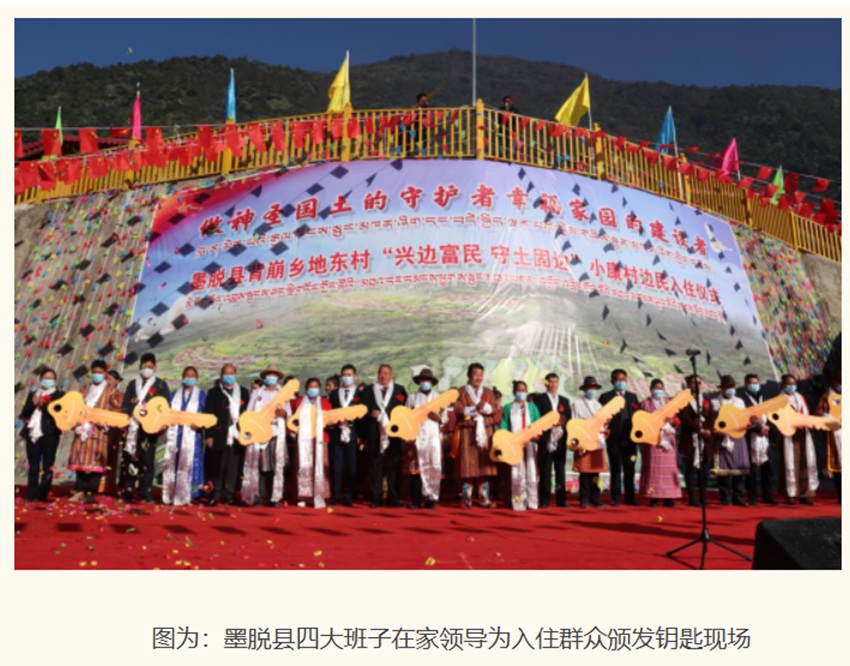
China’s official rhetoric is full of forward momentum, endless growth, ever onwards and upwards, conquering new frontiers, with no backsliding. Propaganda slogans repeat endlessly Deng Xiaoping’s invitation to get gloriously rich.
In Xi Jinping’s word torrent: “A new round of scientific and technological revolution and industrial transformation is profoundly changing humanity’s modes of production and life and the world’s development pattern; scientific and technological strength and innovation capacity are increasingly becoming the core competitiveness of nations. We must seize the historic opportunity, meet the challenges of the era, accelerate the advance of high-level scientific and technological self-reliance and self-strengthening, march firmly toward the goal of building China into a science and technology power by 2035, and solidly support and lead Chinese-style modernisation with scientific and technological innovation. We must make forward-looking arrangements for the construction of major science and technology infrastructure. We must give prominence to both the supply of scientific and technological innovation and the pull of industrial demand, and open up the channels through which science and technology are accelerated into transformation as real productive forces. We must participate deeply in global science and technology governance, broadly publicize China’s propositions and China’s solutions, and enhance our discourse power and influence in the making of international rules.”
RACING THE ZHONGHUA MINZU CHINESE RACE
Top leader Cai Qi “delivered an address on behalf of the Party Centre titled ‘Strive to Run the ‘Critical Leg’ of the Relay Race of Building a Science and Technology Power.’ Cai Qi pointed out that the 15th Five-Year Plan period is a critical period for laying the foundation and exerting full effort toward basically achieving socialist modernization, and also an important stage of overcoming difficulties and storming passes in building a science and technology power. He expressed the hope that the broad masses of science and technology workers will firm up their ambition to serve the country through science and technology, bravely shoulder the mission of self-reliance and self-strengthening, lead the trend of social civilization.”
AI deployed by China’s influencers, musicians is now utterly addictive. AI is attuned to give expression to what no-one is sure they are allowed to articulate, their anxiety, alienation, frustration, AI has become the “mouth substitute” 嘴替.
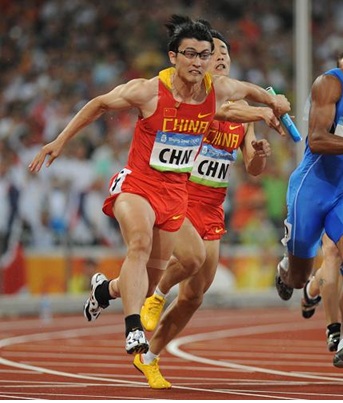
The push to accelerate, then accelerate further, is endless, and demands mobilisation of every Chinese, no matter how remote their home pastureland. Everyone must achieve maximum productivity, which can never be achieved at home on the range. This is a relay race, everyone must contribute. Team China must win.
China proclaims itself author of all it gazes upon, including minds. China’s central planning, at national and provincial levels, is now lengthy, prescriptive, covering all aspects of the phenomenal world, all landscapes and human lives, all that can possibly be intensified and accelerated, including human minds. Reading the latest Five Year Plans is a marathon of commands, they demand endless construction, expansion, acceleration, agglomeration, upscaling, of body and mind. of each and all. Whether the object of the gaze of the party-state is infrastructure construction or mental rectification of citizens’ minds, the language is uniformly stentorian legislative voice.
For example, chapter 37 of the Gansu province Five Year Plan 2026-2030, a quite typical slice of a very long document: “Enhancing the Level of Civilization in the Whole Society: Adhere to the principle of focusing on construction and establishing a foundation, persist in long-term efforts and perseverance, strengthen the construction of socialist spiritual civilization, and promote the formation of ideological concepts, spiritual outlook, civilized customs, and behavioural norms that meet the requirements of the new era. Using the Party’s Innovative Theories to Unite and Forge the Soul: Persistently use Xi Jinping Thought on Socialism with Chinese Characteristics for a New Era to unite and forge the soul, and promote the normalization and institutionalization of education on ideals and beliefs. Improve the public opinion guidance mechanism and the collaborative mechanism for public opinion response. We must strengthen the development of socialist spiritual civilisation and promote the formation of ideologies, mentalities, civilised social norms and standards of conduct that meet the requirements of the new era. Uniting Hearts and Minds with the Party’s Innovative Theories.”
To situate these demands, in context, the quoted text is in a section on strengthening Gansu as a cultural tourism destination, immediately after a section on urban agglomeration. Tone and the language of command are the same throughout.
SMELTING TIBETAN CIVILISATION
China’s leaders are adamant that AI, robots are the future, but what they label as “traditional industries” must persist. None is more traditional than smelting ore into pure metal, a process so familiar it is also the official metaphor of the 2026 Ethnic Unity Law moulding Tibetan civilisation into pure Chinese:
“The key lies in the active verb “铸牢.” The first character is metallurgical: to cast molten material into a mould. Paired with the second character, which denotes firmness, enclosure, and confinement, the phrase conveys controlled production: the deliberate casting and stabilization of identity under Party-state direction. The object of this process, 中华民族, is not a neutral synonym for “the Chinese nation. In earlier policy frameworks, it coexisted with a plural system of 56 officially recognized nationalities 民族, each with a distinct identity and a nominal sphere of autonomy. In the new law, that plurality is reconfigured into a singular civilizational subject, within which diversity is recoded into a hierarchical structure. Finally, what is officially rendered as a “sense of community” 共同体意识is better understood as a desired form of collective consciousness. While a “sense” may emerge organically, a “consciousness” 意识 must be shaped, tested, and evaluated.”[12]
OPTING OUT
Tibetans, like so many disillusioned young Chinese, find this marathon sprint exhausting. Across China many Han now refuse to endlessly compete in a race skewed to benefit the well-connected. They quietly opt out, “lying flat”, since openly dropping out is forbidden.
Tibetans have deeper responses to the demand, frequently repeated in official decrees, for endless acceleration. A core proposition, familiar to all Tibetans, is that abiding, always-on happiness comes not from material accumulation but from cultivating an inner joy that arises from learning to roll with the tumult of thoughts and emotions, and not get captured, often overwhelmed by them. Not so many Tibetans actually do the mind training, yet have encountered trained Tibetans at ease, under all circumstances, manifesting the results of classic traditional mind training. They are Tibet’s culture heroes.
It is this cultivated inner contentment that is not only invisible to materialists, it is an obstacle if the goal is endless acceleration.. That is why, 40 years ago, the Chinese economists sent to Tibet to kick start desire, aspiration, acquisition despaired that they could find no cravings.
Now, decades later, desire to consume has arisen in Tibet, perhaps the last in the world to discover the addictive treadmill of production and consumption in a material world, joining what Marx called the exchange economy, in which workers and their work are commodities whose adding of value can be extracted by the rich and powerful party-state.
Achieving saturation smart phone coverage, and saturation phone ownership, even in remote Tibetan lands, took longer. “Achieving complete Wi-Fi coverage in Tibetan-populated areas is difficult; however, reducing internet tariffs is a significant matter for Tibetan people. Operators such as China Mobile and China Telecom should genuinely act in the spirit of serving the people, implementing preferential measures to further reduce mobile phone call fees, internet access fees, and broadband fees, allowing them to use the internet without economic pressure, obtain necessary cultural, wealth-generating, and informational resources, and enjoy the benefits of modern information technology, thereby improving their quality of life.”
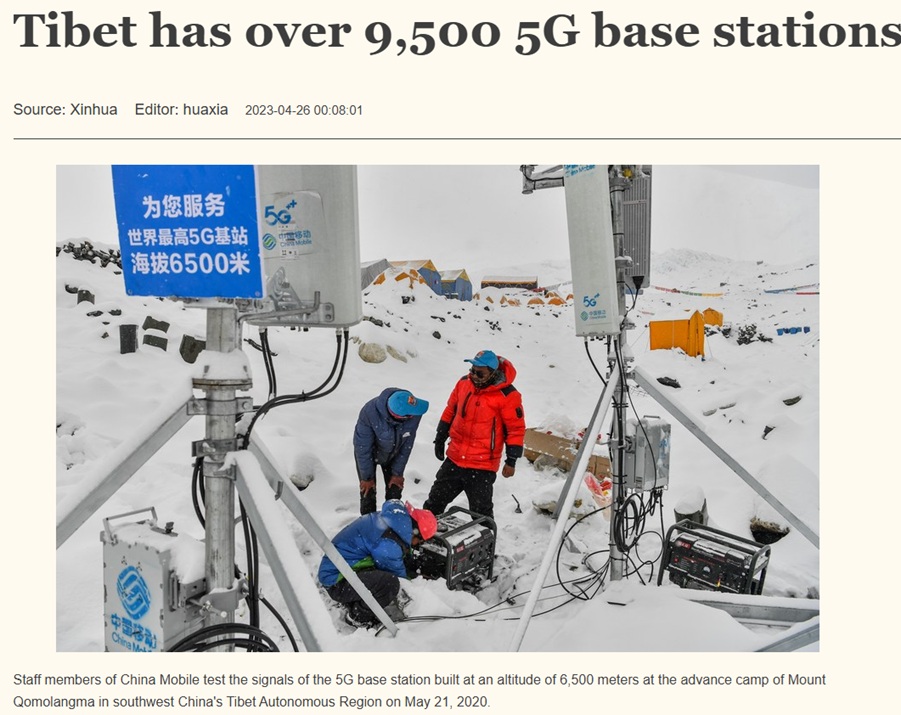
Now fast 5G access is everywhere, and Tibetans, as throughout China, own at least one smart phone. “As of the end of April 2026 the total number of mobile phone users of the three basic telecom enterprises and China Broadcasting Network reached 1.838 billion, a net increase of 10.92 million from the end of last year. Among them, 5G mobile phone users reached 1.262 billion, a net increase of 57.58 million from the end of last year, accounting for 68.7% of all mobile phone users. The 5G user penetration rates in the eastern, central, western, and northeastern regions were 68.1%, 69.5%, 68.6%, and 69.4%, respectively, all exceeding 68%, indicating further improvement in regional development balance.”
In sparsely populated Tibet this is a remarkably intensive installation of phone towers, coverage everywhere. For the security state the payoff is real-time tracking of smart phoned locations, enabling quick identification of Tibetans gathering. Even in remote areas Tibetans now say if their cousins or friends come round, to socialise, you can expect police will soon come to check.
The other payoff is enabling immediate online access to glamorous Chinese influencers, lifestyle trendsetters, everything conducive to addictive desire, and dissatisfaction with the quiet life of inner contentment. Pastoral life is boring, when life could be exciting. China’s smart phone influencer culture is a vector of disease transmission, the disease of grasping, craving.
FORCED INTO THE MOULD
Tibetan ethnographers doing fieldwork in Tibet identify the shift in the last decade of last century and the 21st century’s first decade, closely aligned with China’s insistence on compulsory schooling. Until the 1990s schooling was legally compulsory but in Tibetan areas not enforced, and many families chose to keep their children in the family, both because farming and livestock management are labour intensive, and because schooling beyond primary grades required sending children away, to learn Chinese, and come back with the wants and aspirations of Deng Xiaoping’s “to get rich is glorious” slogan.
In the 1990s policing of school attendance intensified. In 2001 China legislated to make standard putonghua Chinese the medium of instruction in schooling.[13]
By 2015 Tibetan teachers explained to interviewers from Human Rights Watch: “They [the authorities] are not supporting Tibetan language anymore, that is very obvious. They are opening lots of kindergartens where the language medium is required to be Chinese. This kind of thinking has spread everywhere. So, the children would only understand Tibetan until they got to the kindergarten; then they’d start to think Chinese is more important. In primary school, a lot of the kids in a way don’t like Tibetan because they think it will be quite useless, it’s only a small percentage of the overall score in exams, and the teaching methods are outdated. When I was in school in the early 1980s, it was a Tibetan medium, when my husband was teaching, there was a bilingual model, a pure Tibetan-medium model, during the Panchen Lama’s time, but by the 2000s the medium was Chinese. These students who have stayed in school for a few years imagine that they are going to get a government job in the end, they won’t have to work on the land, and they look down on their parents. They’re close to the city and they lose their identity. And when they get to exam for middle school, then 90 percent of them fail and that’s the end of it. They go to work on construction sites, or do anything, nothing. They might lose contact with the family back in the village.”[14]
MONOGLOTTAL STOPS
Chinese language is the vector for inculcating Chinese values. A command back in 1994: “Patriotic education is education for all people, with a focus on youth. Schools, the army, towns, villages, neighbourhoods, organizations, enterprises, should regard cultivating a sense of patriotism among youth as critical dimensions of ideological and political education, promoting their patriotic consciousness and guiding them to establish correct ideals, beliefs, values, and outlook on life. At present and in the future we must carry out education in the Party’s basic line, education in Chinese modern and contemporary history and national conditions, and education in the traditional virtues and fine culture of the Chinese people. Schools are important sites for the education of young people. We must carry out patriotic education in a way that encompasses the entirety of the process, from the level of daycare to the level of university education, especially making sure that teaching in the classroom plays a major role in this process.”[15]
Place, especially the home place on the farm or the winter home on the range, no longer shapes identity, once children of kindergarten age are displaced from home and family, then discovering the hard way the boarding school is incapable of loving them, as parents do. At an early age institutionalised children learn to repress emotions, which inevitably are displaced onto objects of desire, consumable beckoning online. Labubus for the lonely. They are a first generation socialised not by place but by connectivity. Their formative communities were not the village or farm but the group chat, the feed, the server. They are consuming the same content, at the same time, shaped by the same recommendation algorithms.
Only a decade ago socialising with other young Tibetans meant gathering in village and township teahouses. Only there was connectivity available, and distance vanished.[16] Now you can be anywhere, any time, which makes here, behind a yak pulling a plough, so boring.
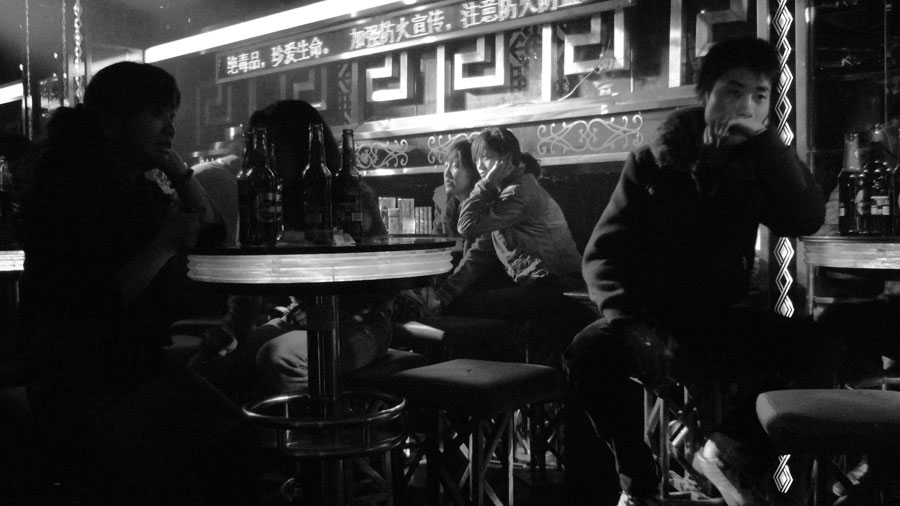
Ethnographer Dorje Tashi: ““Young Tibetans, however, do not share their views. For the younger cohort, the urban is characterized not by public infrastructure but rather by non-agricultural labour, spaces that give them freedom, availability of amenities such as shops, bars, malls, and movie theatres, and non-agricultural employment opportunities. Tibetan youth describe their villages as boring and a place of narrow-minded people. In contrast, cities are understood as progressive, developed centres, and thus modern. Young Tibetans’ perception of rural/urban and village/city dichotomies reflect state discourse of quality or suzhi. People who reside in cities, Han Chinese areas, and economically advanced places are understood to have higher suzhi than those living in the villages, minority areas, and other ‘underdeveloped’ backward regions. During our casual chat, when I asked what they like most in Xining, rang dbang (freedom) is what both mentioned first. To gain specific insights on what they meant by freedom, I asked them to provide some examples. “You know, yak yak (makeup) is what most us [girls] like to do, and we can do it here. We are now in the city, not in the village,” said Sangdol. Wearing fashionable clothes are also what young men mostly desired upon their arrival in Xining. For instance, a twenty-two year- old man from Guinan County explained that “ripped jeans are the most stylish jeans everywhere, right? But for villagers, such jeans, including the tight pants for boys are seen as clothes for skya stong (bad boys).”
“Young Tibetans in Xining frequently employ a language of liuxin and shishang, which in Chinese literarily means “fashion,” and deng rabs and deng sang in Tibetan, referring to the modern age, or the contemporary period, to explain the dichotomy of city and village. A young man in his twenties, for instance, noted that:
“People in the village still live in the past. They often like to compare what they see and experience, at present, with similar things they faced and experienced in the old days. They rarely take rapid social transformation (spyi tshogs kyi ‘gyur ldog) and progress (yar rgyas) beyond the village into account in their everyday life. Sangje, a young man from Trika, who worked as a waiter at Jamtsan’s restaurant, had obtained a hotel job in Shenzhen and opted to move there, because it is an even bigger centre for urban amenities.
“For them, the bigger the city is, the more entertaining it is. Moving to a larger city is what most young people desire,” Jamtsan said. Most Tibetan youth also understand that their migration to Xining as an opportunity to “open their ears and eyes,”[17]
Anthropologist Eveline Washul: “the shift in Tibetan views of ‘the good life’ has taken place just in the first two decades of the twenty-first century. During this period of intensified economic development in Tibetan regions, cash income has become increasingly necessary, enhancing the importance of schooling as a path towards wage-based employment. The rise of schooling and the growth of consumerism together with urban development gas meant that rural Tibetan households must seek source of cash income…….. Many Tibetans see obtaining a government job as bringing a family socioeconomic status and financial security. In comparison, pastoral livelihoods are now seen as jobs for the uneducated………..I often heard anecdotes about these discouraging odds discussed by Tibetan students and professionals who either sat for these recruitment exams or knew someone who did, Despite the odds, the dream of a government post remained a strong motivation for households to send their kids to school.”[18]
SPECTACULAR MODERNITY
China now has carrots as well as sticks, attractions as well as coercion, a full menu to devalue and depopulate rural Tibet. Perhaps there are now only two obstacles to a mass outmigration of young Tibetans to the cities, First is the security state’s fear of Tibetan crowds, which continues to refuse urban hukou household registration to displaced rural Tibetans, who are instead parked, by decree, in an archipelago of frontier villages. Second is widespread popular Han racist disdain for Tibetans as an unwashed, uncivilised, backward tribe not welcome on the streets of the cities. A looming third obstacle is the imminent automation of so many urban entry-level jobs. Nonetheless China’s current 15th Five-Year Plans for Tibetan areas announce detailed instructions for getting Tibetans off their lands and into cities or county towns.
Tibetans in exile in cities worldwide, having already discovered for themselves how to reinvent the self and connect online, have seldom had opportunity to help younger relatives inside Tibet on how to navigate urban modernity. There has been a tendency in Dharamsala to see Tibetans in Tibet as corrupted by Chinese values, as having lost sight of compassion by prioritising competitiveness. Connections are tenuous, throttled by automated surveillance that prevents separated families from speaking their minds.
The coerciveness of China’s campaign to assimilate Tibetans is a strong focus of Tibetan advocacy worldwide. China’s 2026 ethnic unity law was widely analysed and critiqued. Yet the seductions of modernity with Chinese characteristics attract little attention.

Anthropologist Eveline Washul: “Even though the employment options for graduates Are so limited, many Tibetans do not see better alternatives than to forsake the future of their subsistence-based livelihoods and send their children to school. Up to the first decade of the twenty-first century, farmers and nomads considered their livelihoods to be desirable ways of life for their children……. Meanwhile, their parents’ generation with local propaganda contrasting the necessity of schooling and the upward socioeconomic mobility with the ‘backwards’ ways of farmers and nomads, Many from these generations have internalised the state’s valorisation of urban life and devalorisation of subsistence livelihoods… A common self-deprecating warning pastoralist parents give to their young, uncooperative children starkly illustrates the devaluing of pastoral livelihoods. ‘Do you want to become a nomad like me? Because if you don’t do well in school; that’s what you’ll be doing.’’”[19]
Washul’s fieldwork access ended in 2019; since then, the pressure to assimilate has only intensified. So too has smart phone penetration, and the mass appeal 路人缘 lù of influencers telling well the story that your dream, the China Dream, can merge and come true.[20]
The seductive AI-powered side of China’s intensive civilising mission in Tibet gets little attention, because worldwide it is everywhere, in everyone’s lives, overstimulating us all to swing without pause between hope and despair, craving and anger, consumption and remorse. Ain’t nobody going nowhere.
Tibet’s civilisational commitment to embodied awaking is a gift we all could find helpful. There is now an urgency to recognising Tibet as a civilisation, because the mirror Tibet holds up to both Chinese and American onrushing modernities is in danger of being smothered. Tibetan civilisation is being smelted into a Chinese mould.
May the treasure that is Tibetan civilisation be revealed, before it is suffocated.
[1] Rolf Stein, La Civilisation Tibetaine, Dunod Editeur, 1962; Tibetan Civilization, Stanford 1972
[2] Yanis Varoufakis, Technofeudalism and the Future of Capitalism, Savage Minds Substack, 6 August 2026
[3] Four Principal Commitments of His Holiness the Dalai Lama, DIIR, Dharamsala, 2025, https://tibet.net/wp-content/uploads/2025/02/English-Four-Commitments-of-HHDL.pdf
[4] Kaveri Gil, Revival of Ancient Indian Wisdom, 144-6 in Four Principal Commitments of His Holiness the Dalai Lama, DIIR, Dharamsala, 2025
[5] Ven Geshe Lhakdor, Preservation of Tibet’s Culture and Environment, in Four Principal Commitments of His Holiness the Dalai Lama, DIIR, Dharamsala, 2025
[6] Xu Guoqi, The Idea of China, Harvard U Press, 2026New Qing History, https://en.wikipedia.org/wiki/New_Qing_History
James Leibold, Thomas Mullaney, Stephane Gros Eric Vanden Bussche, Critical Han Studies: The History, Representation, and Identity of China’s Majority, 2012, U California Press
[7] Kai-Fu Lee and Chen Qiufan, AI 2041: Ten visions for our future, Penguin 2021
[8] Outline of the 15th Five-Year Plan for National Economic and Social Development of Qinghai Province, 青海省国民经济和社会发展第十五个五年规划纲要(一)https://mp.weixin.qq.com/s/Pq6dwMDqcjPbsLnAloIv9A
[9] Steve Rolf and Seth Schindler, The US–China rivalry and the emergence of state platform capitalism, Environment and Planning A: Economy and Space, Vol 55, Issue 5, August 2023, 1255-1280
Steve Rolf and Seth Schindler, State Platform Capitalism, Cambridge U Press, 2026
[10] Wang Xiaoqiang and Bai Nanfeng, 富足的贫穷furao de pinkun, 1986
Poverty of Plenty, Macmillan, 1991, 158, 165
[11] Yizi, Chen & Xiaoqiang, Wang et al, 1987. “Reform: Results and lessons from the 1985 CESRRI survey,” Journal of Comparative Economics, vol. 11(3), pages 462-478, September
[12] James Leibold, New Law Engineers Unity, China Brief, 6 May 2026, Jamestown Foundation, https://jamestown.org/new-law-engineers-unity/
[13] Zhou, Minglang. (2003). Multilingualism in China: The politics of writing reforms for minority languages 1949-2002. Mouton de Gruyter.
Zhou, Minglang. 2005. “Legislating Literacy for Linguistic and Ethnic Minorities in Contemporary China.” Current Issues in Language Planning 6 (2): 102–121.
[14] Human Rights Watch, China’s “Bilingual Education” Policy in Tibet: Tibetan-Medium Schooling Under Threat, 2020, 92-3
[15] Aiguozhuyi jiaoyu shishi gangyao 爱国主义教育实施纲要, Action Plan for Patriotic Education, Chinese Education and Society, vol. 39, no. 2, March/April 2006, pp. 7–18.
[16]Lilian Iselin, Teahouses and Telephones: Mobile Communication and Spatial Practices of Tibetan Herders in Southern Amdo, INNER ASIA 18 (2016) 37–57
[17] Dorje Tashi /Duojie Zhaxi, Tibetan Farmers in Transition: Urbanization, Development, and Labor Migration in Amdo, PhD thesis, U Colorado,2020. https://www.proquest.com/openview/c3f6fe5aa0ab0a3486b1746cfba445dc/1?pq-origsite=gscholar&cbl=18750&diss=y
Dorje Tashi /Duojie Zhaxi (2019) Housing subsidy projects in Amdo: modernity, governmentality, and income disparity in Tibetan areas of China, Critical Asian Studies, 51:1, 31-50, DOI: 10.1080/14672715.2018.1543548
[18] Eveline Washul, High Lands, Pure Earth: Place making, history and urban transitions on the Tibetan Plateau, Cornell U Press, 2026, 125-6
[19] Washul 126
[20] “Mass appeal” (路人缘 lù rén yuán) is an internet slang term which comes from fan culture. The characters translate as: “passer-by” (路人 lùrén), “affinity” (缘 yuán). In Chinese, a “passer-by” (路人) is a stranger, or a neutral onlooker. In fan circles, it specifically means people outside the fans of a particular celebrity: they are not fans, not haters, just the general public. The second part, “affinity” (缘), is the same character used in “fateful connection” (缘分), the bond that draws people together. So “passer-by affinity” is the appeal a celebrity enjoys among people who aren’t their core fans. The phrase emerged in the early days of the Chinese internet as “fan-circle slang” (饭圈流行语). It describes stars who are liked even by people with no interest in celebrity culture. Explanation by Andrew Methven https://substack.com/home/post/p-205782325