Inventing a low-altitude economy in high-altitude Tibet
The genius of capitalism goes beyond endless invention of new products and new markets. China’s state capitalism, especially its civil-military fusion campaign 军工协会 , is capable of inventing entirely new asset classes, based on inventing new human needs.
Who knew that China is in need of military drones designed to fly at the highest Tibetan altitudes? Who knew these drones have myriad civilian uses as well?
It is the invention of a new economic realm, at low altitude, that is new. China’s multiple models of drones based in Tibet to threaten India are not new, and the Indian military keeps a close watch. Brigadier Anshuman Narang tracks them all.
https://www.youtube.com/watch?v=pOf_dOP5pYc
China’s endless quest to turn Tibet into money attracts not only top-down state-owned hydro infrastructure builders, but also niche entrepreneurs marketizing aspects of Tibet for profit. Here are two examples, from opposite ends of Tibet, of Chinese capitalism inventing new products, sometimes inventing a whole new economy by locating a market in spaces no-one ever imagined could be packaged as new productive assets.
In upper Tibet Ngari in Tibet’s far west, close to the Himalaya and Ladakh but in rain shadow, arid as well as cold. Although Tibetan civilisation originated in upper Tibet many thousands of years ago, when the climate was wetter, drought long ago pushed Tibetans eastwards, abandoning the stony irrigation channels archaeologists find today.
Tibetans everywhere still revere upper Tibetan Mt Kailash and the nearby sacred lake Mapam Yumtso མ་ཕམ་གཡུ་མཚོ།, a divine dyad, god and goddess, that attracts pilgrims from across Tibet, India and Nepal, walking the rough path round the holy mountain to cleanse minds of attachment to wealth: the antithesis of market making. China has tried packaging Kailash Sacred Landscape as an international tourism destination, but the politics of frontier conflict ended that before UNESCO World Heritage could be asked to confirm.
If two days of walking the pilgrim path round the foot of Mt Kailash/Gang Rinpoche is not for you, you can now take the two minute drone camera shoot right up the top of Kailash and all the way down again.
FROZEN CONFLICT
Geostrategists call conflicts that seldom flare but never go away and are never resolved, “frozen conflicts.” If ever there was and is a frozen conflict it is on the rock and glaciers of the Actual Line of Control high in the Himalaya, where Tibetans in Chinese uniforms confront Tibetans in Indian uniforms, sometimes fatally.
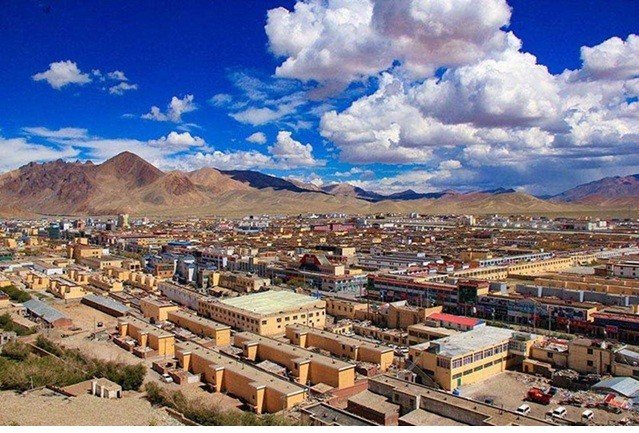
So Ngari (Ali 阿里地区in Chinese) is highly militarised, including a military airstrip inconveniently far from Kailash, necessitating the construction of a tourist drome as well. Ngari skies are mostly for military flights, sometimes weather balloons ascending to the stratosphere. Cloud seeding flights, not so much.
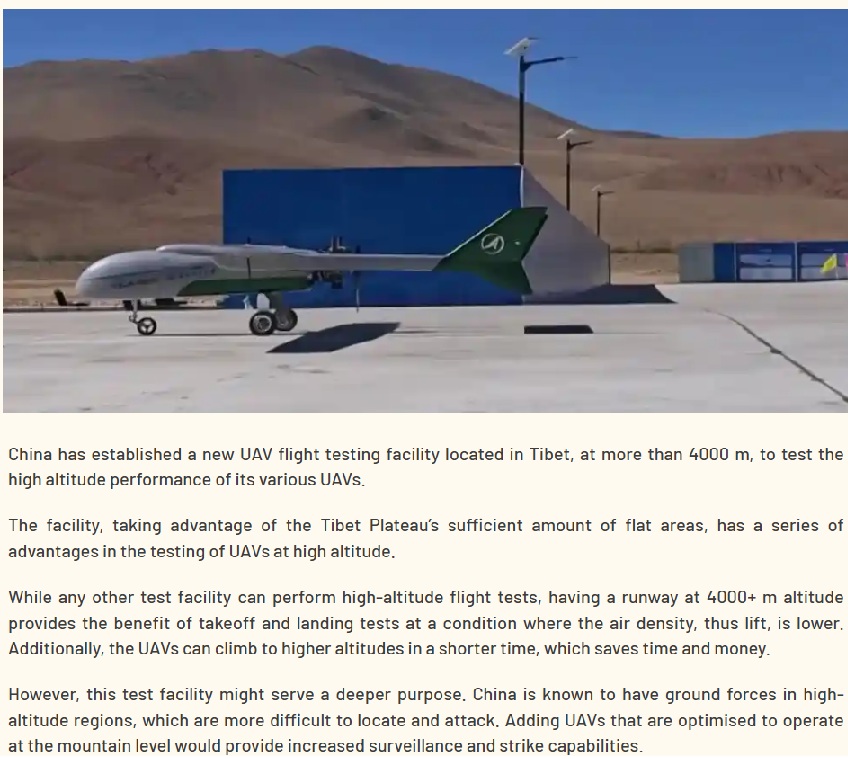
What no-one, until now, could imagine is turning the sky just above Ngari into a marketable commodity, a newly investable category. Now is the hour of the drone; not a small quadcopter with camera, but a full scale pilotless aeroplane capable of carrying weapon payloads. The military market is already assured, because frozen conflict requires eternal vigilance, and because drones can be controlled remotely, part of China’s general strategy of governing Tibet from afar.
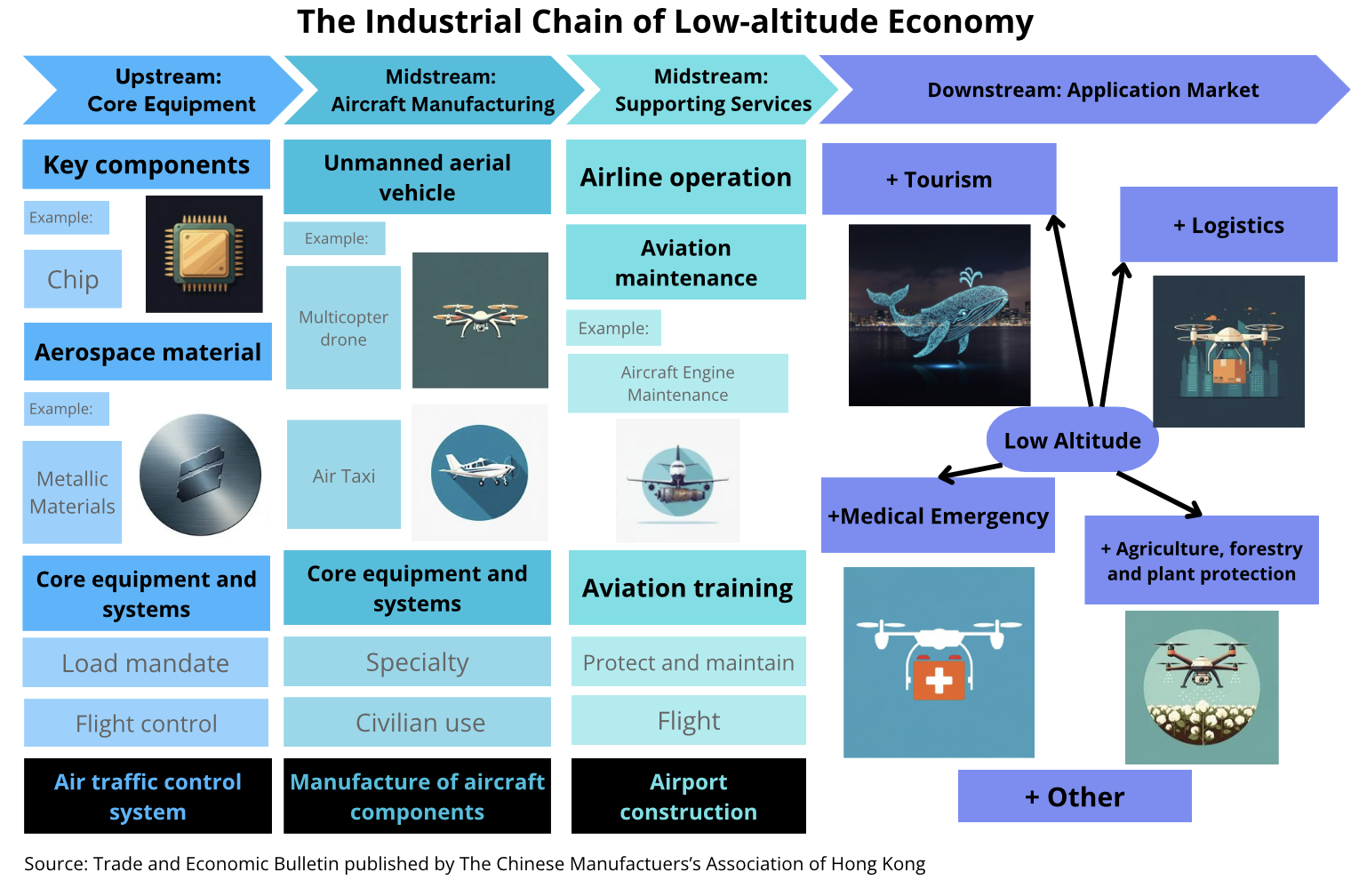
But are there other markets which need to discover they need dronification? Meet the low-altitude economy, a worldwide reinvention of the skies just above, as a marketplace of new tech. Where better to make Tibet a low altitude economy than at the high altitude of Ngari upper Tibet? If you can make a drone that flies there, you can make it anywhere.
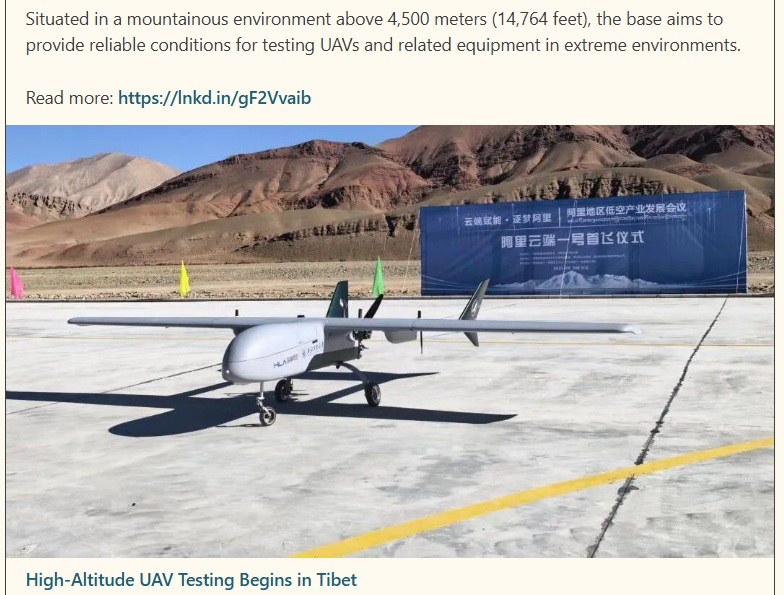
“On 28 September 2025, China’s first high-altitude plateau unmanned equipment testing base, situated over 4,300 metres above sea level, commenced operations in Tibet’s Ali region. This facility provides a vital platform for testing unmanned systems in high-altitude environments and plays a significant role in advancing the development of the low-altitude economy.
“Reporters learned from the Ali Region Low-Altitude Industry Development Conference that the region, with an average elevation exceeding 4,500 metres, features complex and diverse topography, thin air, low oxygen levels, and reduced atmospheric pressure. This environment supports abundant low-altitude applications such as tourism, emergency rescue, road patrols, disaster monitoring, and environmental protection, earning it the moniker “the ultimate testing ground for aircraft.” The region prioritises low-altitude economic development as a key driver for high-quality growth and cultivating new productive forces, actively exploring the “low-altitude plus” model. It will expand low-altitude sightseeing tourism while vigorously developing new applications such as “drones plus emergency rescue” and “drones plus ecological monitoring”, striving to establish Ali as a new hub for Tibet’s low-altitude economic advancement.”
This is civil-military fusion in practice, featuring an impressive list of players making Tibet their proof of concept proving ground: “Northwest Polytechnic University High-Altitude Low-Altitude Equipment (Tibet·Ali) Testing Base, the New-Quality Equipment Energy Technology Industry-Academia-Research Collaborative Innovation Consortium High-Altitude Testing Base, and the Civil Aviation Flight Association of China Tibet Region UAV Industry Joint Training Base.”
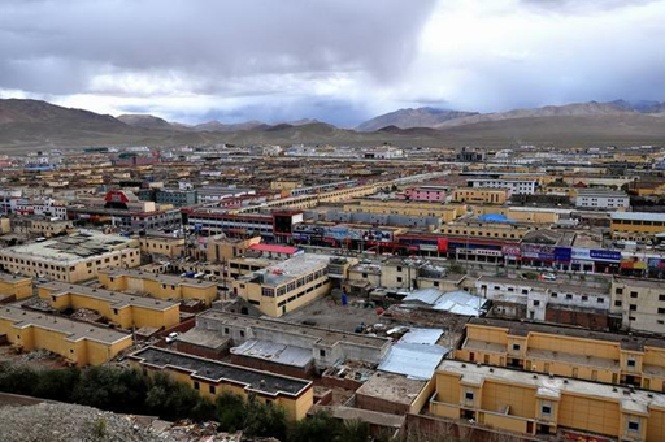
So Tibet now has a low-altitude economy, where these very noisy drones, designed for military payload, hunt for a market.
The low altitude is the realm of the birds, such as the bar-headed geese which twice a year fly across the Himalaya, to winter in India, returning to Tibet for summer. The geese even tolerate the presence of small camera drones nearby. Big military drones, the kind you see in Gaza and Ukraine news, not so much.
LAYERS OF SURVEILLANCE
The skies above Tibet are now a civil-military multi-layer cake of economies and technologies, all in the name of security.
There are now several layers above Tibet, which are increasingly militarised, and increasingly profitable. Don’t confuse the low altitude economy with low earth orbit (LEO). Intensive surveillance of Tibet is largely automated, done by satellites. Cameras stationed permanently above Tibet are able to be stationary because they are so far above, gravity has little pull. Satcams below them, in LEO low earth orbit have to whiz past quickly, to resist the pull of gravity. So surveilling Tibet, and the entire planet, from low earth orbit requires hundreds or even thousands of satellites streaming endlessly overhead.
“Cheaper, miniaturized satellites are critical to the economic viability of low Earth orbit (LEO) mega-constellations—groups of hundreds to tens of thousands of satellites in LEO. However, unlike GEO satellites that remain in a fixed position relative to the Earth, LEO satellites close to the Earth’s surface move quickly, providing coverage in a given area for only a short time. Ensuring continuous coverage for terrestrial users requires networks of hundreds or thousands of satellites, so the same location on earth’s surface remains continuously serviced (i.e., a proliferated constellation). Moreover, the satellites must communicate with each other to handoff data transfers as different satellites orbit out of range and new ones replace them.”
The invention of a Tibetan low-altitude economy might seem ridiculous; but the serious side is that drones, in swarms, are the future of war worldwide. So says the editorial board of New York Times, December 2025.
China’s launch of military attack drones designed for high altitude warfare has serious implications for neighbouring India.
TIBET POWERS CHINA’S DRONE PRODUCTION INDUSTRY
There is quite different way in which Tibet is entangled in China’s drone warfare industry. Not only is Tibet required to pioneer new frontiers of the low-altitude economy, Tibet’s rivers, sun and wind directly electrify China’s drone design, manufacturing and exporting to wars worldwide. Tibet’s electricity is designated for Shenzhen, the new city adjacent to Hong Kong where the drones are tested, patented, mass produced and profitably sold to slaughter Ukrainians defending their homeland from invasion.
https://www.tibet3.com/news/zangqu/qh/2025-12/09/content_500358906.html
Tibet has no say in its valleys being expropriated for hydro dams, its pastures for solar arrays that stretch many kilometres in all directions, nor the wind turbines positioned on the hilltops above. Taken together these technologies are all for Shenzhen, transmitted thousands of kilometres to Shenzhen in a fraction of a second.
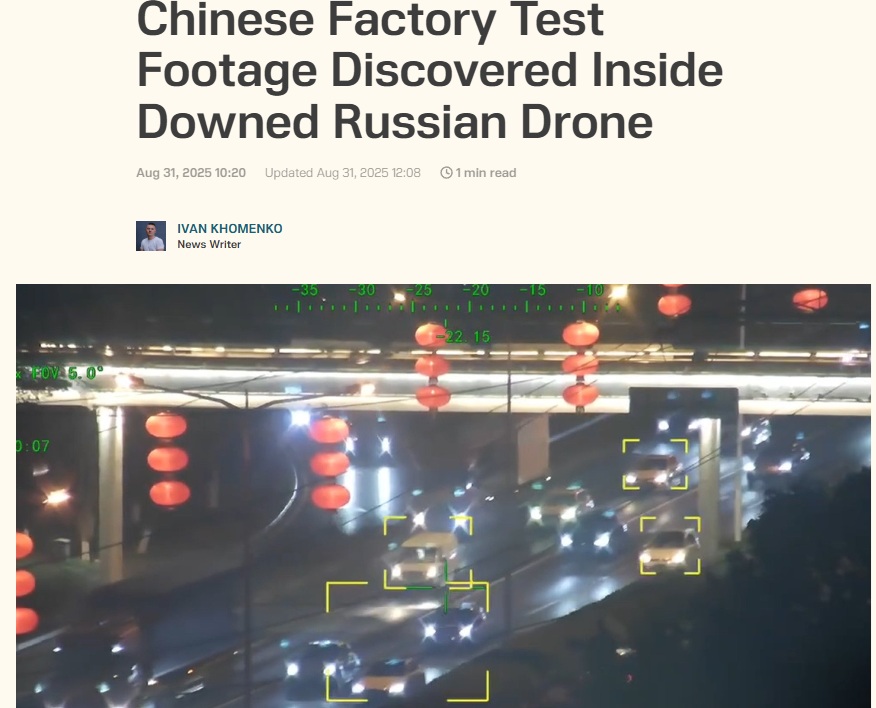
China’s formidable drone manufacturing industry is booming, for two reasons: preparing to overwhelm Taiwan, and for global sales, especially to Russia, a voracious consumer.
A closer look at the drones, and key component electric motors installed to power drones, all made in Shenzhen, reveals how small drones in action, against Ukraine, are revolutionising warfare. Shenzhen as the drone production hub in turn links to Tibet as the source of the electricity supplied to Shenzhen, that is essential to Shenzhen-based drone design, drone testing (for secrecy indoors), drone manufacture and export in bulk to Russia. Shenzhen and its privileged special status rely on Tibet for its electricity. This makes Tibet involuntarily involved in the Ukrainian genocide, via Shenzhen. Not where any Tibetan would choose to be.
The biggest of ultra-high voltage (UHV) power grids from Tibet to Shenzhen is scheduled for completion by 2029, with other grids from Amdo/Qinghai to Shenzhen, nearby Hong Kong, and Guangzhou. Shenzhen’s electricity demand, to feed its high tech “high quality new forces of production” “高质量新型生产力”in Xi Jinping’s favourite phrasing, is so great that several grids from several Tibetan landscapes are snaking towards Shenzhen.
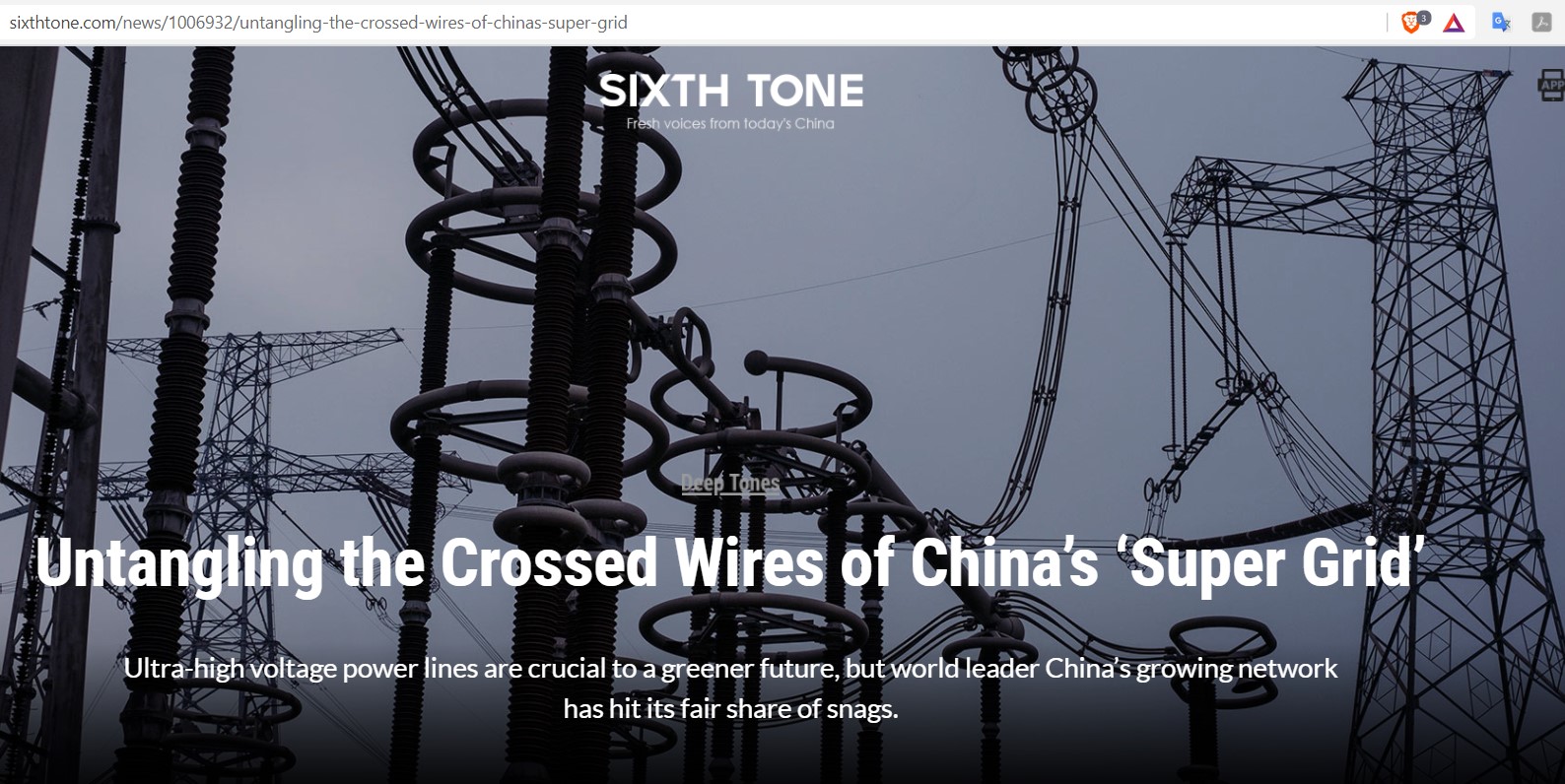
UHV is the key to achieving China’s global dominance in grid construction, and to China’s colonial extraction of energy from Tibet and Xinjiang, as hinterlands ready for exploitation, not only because there are strong winds, plentiful sunshine and rivers that can be dammed; but also because both Amdo/Qinghai and Xinjiang have coal that feeds into electricity production, and above all, population is by Chinese standards scattered, small and readily shunted aside.
Based on this assessment of Tibet and Xinjiang as electricity production bases, there is now urgent need for ultra high voltage power grids, the longest is 3300 kilometres, to connect supply and demand without dissipating into heating an already heating atmosphere further.
It is this urgency that results in a furious pace of UHV grid construction that locks remote locations into core functions of China’s power-hungry hi-tech hubs. Beyond China there are a few power grids of comparable ultra-high voltage, but not many. China by 2024 had announced almost 40 such grids.
The urgency of the race to own the future drives corporations in Shenzhen to demand employees work very long hours. Similarly the demand, especially from Russia, for drones and electric motors for drones, also requires not only massive amounts of electricity but also highly reliable delivery of electricity, more reliable than variable wind and sun. This why coal fired power is intrinsic, built in as the long term source of electricity, output dialed up and down in step with demand, when “green energy” supply lags behind demand. Coal is still king, and not just in the 24 hour cycle of fluctuating supply and demand, hydro is seasonal, Tibetan rivers rushing in summer, low streamflow in winter. Again coal to the rescue. New coal mines have been opened recently in Qinghai, notwithstanding Qinghai’s several decades of declaring itself “China’s Number One Water Tower.”
UHV is problematic:
- because it perpetuates coal fired power generation,

- because Tibetans have no say at all in whether their rivers are dammed and UHV is transmitted to distant Henan, Guangxi and Shenzhen. By 2025 22 of China’s 30 provinces receive electricity exported from Tibet. https://www.tibet3.com/news/zangqu/qh/2025-12/09/content_500358906.html
- and also because UHV tech relies on switchgear that is exceptionally bad for climate: “Sulphur hexafluoride (SF6) gas has long been used in high-voltage switchgear components, such as circuit breaker interrupter chambers, gas-insulated substations, and instrument transformers, due to its excellent insulating and arc-quenching properties. However, while SF6 is a great gas for these applications, it is also a potent greenhouse gas (GHG) with a global warming potential (GWP) about 24,300 times that of carbon dioxide (CO2), according to the Intergovernmental Panel on Climate Change’s (IPCC’s) Sixth Assessment Report (AR6). That means that it is 24,300 times more effective at trapping infrared radiation than an equivalent amount of CO2. SF6 also has an atmospheric lifetime of 1,000 years.”

The urgency has swept aside decades of Chinese research reports which routinely blamed stupid, careless, ignorant Tibetan nomads for causing desertification. Now the desertification of northwest Amdo, driven by harsh winds from Xinjiang and by global climate change, is suddenly an asset: more wind, more sun, conveniently close to hydropower dams and coal mines, it’s a package deal.
The latest, announced 30 Nov 2025, is huge: “the project will annually deliver 36 billion kilowatt-hours of green electricity to the Guangdong-Hong Kong-Macao Greater Bay Area, marking Qinghai’s third green energy corridor following the “Qinghai Power to Henan” and “Qinghai Power to Guangxi” initiatives. The project, with a total investment of nearly 73 billion yuan, features a planned power generation capacity of 19.44 million kilowatts across wind, solar, coal-fired power, and electrochemical storage facilities. It will transmit electricity directly to Guangdong via a single ±800-kilovolt ultra-high-voltage direct current transmission line with a capacity of 8 million kilowatts. Upon completion, the project is expected to generate an average of 36 billion kilowatt-hours annually, holding significant strategic importance for optimising China’s national energy layout and supporting high-quality development in eastern regions.
“Situated on the Qinghai-Tibet Plateau, Qinghai possesses uniquely advantageous resource endowments/uniquely endowed natural resources. 的青海拥有得天独厚的资源禀赋. The province boasts 100,000 square kilometres of desertified land suitable for photovoltaic development, with exploitable solar energy exceeding 3 billion kilowatts and wind energy potential surpassing 75 million kilowatts. It has emerged as a vital clean power production base in China.
“In early 2024, the National Energy Administration designated the transmission corridor for Qinghai-Hainan Clean Energy Base as one of ten inter-provincial and inter-regional power transmission routes confirmed in the mid-term adjustment of the national power plan for the 14th Five-Year Plan period. By March 2025, the National Energy Administration confirmed Guangdong as the destination province for this transmission corridor.
“’We shall anchor our efforts to the objectives of ‘green dominance, 绿色主导, stable reliability, multi-energy coordination, and intelligent efficiency’. By fully leveraging our corporate strengths and collaborating with all participating construction units, we will advance the project safely, with high quality and efficiency, injecting fresh, robust momentum into the high-quality economic and social development and comprehensive green transformation of Qinghai and Guangdong provinces,’ stated Liu Mingsheng, Party Secretary and Chairman of the State Power Investment Corporation.”
The voltage is as high as the grid designed to take electricity from damming the Dri Chu/Yangtse and the Yarlung Tsangpo, but with coal added, and a big investment in lithium batteries -electrochemical storage facilities- as well, with the lithium also conveniently close by in the Tsaidam Basin. For Shenzhen, Amdo is the electricity source with the lot. That may be why the launch was announced not at a hydro dam but in an industrial zone close to Xining, in the Ganhe Industrial Park, as the project agglomerates many sources of energy from many locations, all coming together for scaling up into conversion from AC to DC, further industrialising the most industrial part of Tibet.
To understand this urgency, we should look more closely at what Shenzhen uses so much electricity for. The key slogans declared at the November 2025 launch are
‘绿色主导、green dominance
稳定可靠、stability and reliability
多能协同、multifunctional and collaborative
智慧高效 intelligence and efficiency.
Tibet choicelessly collaborates in its colonisation, badged as a splendid display of efficiency and reliability, core values of the red engineers.
Shenzhen is the engine room of China’s urgent mobilisation of all factors of production to make China’s century an unchallengeable reality, dominating all rising industries, civil and military. Beijing gives Shenzhen a special status, and has deep connections with top party-state leaders, bypassing provincial government.
“Shenzhen is increasingly seen as
- a vital node in advancing national objectives,
- notably upgrading China’s industrial capabilities,
- managing cross-border political risks,
- and navigating escalating geopolitical tensions with the United States.
“Within this framework, its role has evolved from a site of open-ended market experimentation to one of targeted, centrally aligned innovation. Crucially, the discretionary space granted to Shenzhen is no longer primarily aimed at supporting open-ended, market-led innovation. Instead, it is being reshaped to serve specific national priorities.
“The city’s reform agenda now aligns closely with Beijing’s broader political and economic objectives. The current model represents a more structured, centrally managed arrangement. While local initiative is still encouraged, it is tightly regulated by a central apparatus focused on coordination, oversight, and alignment with national strategic goals. In this sense, Shenzhen offers a revealing example of how governance under Xi Jinping is evolving – from permissive delegation of power to a more hierarchical, structured mode of collaboration.”[1]
IMPERIAL AMBITIONS
Shenzhen is the frontline of Xi Jinping’s insistence on achieving dominance, as fast as possible. Official media say: “the giant ship of China has braved the wind and rain and moved forward. Technological innovation has injected strong momentum into the construction of a modern industrial system. Future investment potential in infrastructure and livelihood areas is huge, and the talent dividend, especially the “engineer dividend,” is constantly strengthening… The certainty of future growth and development trends has become a solid footnote to “believing in China is believing in tomorrow.”[2]
Tibet has no choice but to supply its landscapes, waters, electricity, sun and wind to feed this endless ambition. Tibet has no choice but to accelerate, as China inserts its extractivist ideology, reducing Tibet to an involuntary provisioner of lands, rivers and skies repurposed as assets fed into China’s value chain.
China represents this as normal, adding value so as to benefit Tibetans, make Tibet prosperous. China says this is all natural, a turn away from poverty, and into efficiency, making all factors of production, including humans, more productive. The language of productivity, efficiency, scale, human capital formation is pervasive in nation-building with Chinese characteristics. It is a wrench to remember that, to Tibetans, this is not natural at all. As historian of capitalism, Sven Beckert says: “capitalism is not the natural order of things. Organizing economic life along capitalist logic is a revolutionary departure from much of human history. We need to start by seeing the world we live in not as natural or as the kind of economic logic that animated economic life throughout human history, but as a very particular moment in human history.”
WEAPONISING RUSSIA FROM SHENZHEN
Plunging back into drone warfare, we discover Putin’s dependence on China, specifically on Shenzhen, for bulk supply of the electric motors that drive drones assembled in Russia. When Russia invaded Ukraine in early 2022, the Ukrainians were first to innovate, quickly improvising drone designs that enabled access to Russia’s front lines. Then Russia, with much assistance from North Korea and China, developed new drones, which, analysts say, has been crucial to Russia’s ability to grind slowly deeper into Ukraine, year after year.
The China-Russia friendship “without limits” has price limits set by China, as drones are at the heart of Russia’s capacity to grind deeper into Ukraine, and perhaps end the war on Russia’s terms.
Belorussian investigative journalists tell us that “According to Vladimir Putin, Russia sent 1.5 million drones of all types in 2024 to be used in the war against Ukraine. The bulk of this number were FPV-copters, such as VT-40. One such drone requires 4 engines and dozens of electronic components.”
A leading Russian corporation assembling drones from Chinese and Russian components is OOO Rustakt. “During the last three years Rustakt bought 3,472,360 electric engines for the total price of about $90 million from 3 Chinese companies: Shenzhen Minhuaxin Technology CO., LTD, Shenzhen Nasmin Technology CO.,LTD and Shenzhen Kiosk Electronic CO., LTD. This would be enough to use in 870,000 copters.”
Ukraine begged the US for sophisticated and expensive firepower, such as HIMARS, but as soon as a HIMARS launcher reveals its location by firing, a cheap Russian drone can obliterate it in minutes, destroying a frontline multiple launcher costing millions.
Shenzhen-based businesses now invest directly in Russian drone makers. Investigative journalism by Financial Times, November 2025, reports that “The owner of a major Chinese drone parts supplier has taken a stake in one of Russia’s leading drone companies, highlighting a deepening relationship between Moscow and Beijing’s military-industrial complexes. A company filing, made in September 2025 and seen by the Financial Times, listed Wang Dinghua as the new owner of 5 per cent of the shares in Rustakt, a manufacturer of the VT-40 first-person-view drone widely used by Russia in attacks on Ukrainian forces. Shenzhen Minghuaxin and other companies owned by Wang, a businessman based in the southern Chinese city, have been big suppliers of drone parts to Rustakt and its allied companies. This new tie-up marks a previously unknown level of co-operation between a Chinese company and a Russian military supplier. The low cost and availability of the VT-40 attack drone have made it a workhorse for the Russian military in Ukraine. Its mass production, low cost and availability make it a consistent workhorse for Russian forces. Minghuaxin has shipped $304mn of parts to Rustakt, as well as $107mn of goods to an associated Russian company, Santex Plant. According to the customs records, Rustakt has bought $110mn of lithium-ion batteries from Minghuaxin, as well as $87mn of motors, and $64mn of controllers since mid-2023.”
FORCE PROJECTION: TIBET AS PLATFORM
By occupying Tibet, China has the inbuilt advantage of occupying the high ground, an advantage deployed in 1962, when People’s Liberation Army swept down into Arunachal, meeting little resistance from Indian troops barracked far below in cantonments on the plains. A humiliation India cannot forget.
In the decades since, India has laboured strenuously to build the roads, tunnels and logistics to get men and materiel up, up, up the Himalaya, along its length, with forward positions manned by Tibetans, the jawans of India’s border force, mitochondrially capable of handling thin air and the extreme cold.
That uneasy balance, lasting several decades, is undone by China’s drones. Those drones are designed to carry a substantial explosive payload, flight path controlled remotely, deployable in swarms that overwhelm defensive gunnery. India is unready for a war of machine against machine, a war which can be won or lost in hours, much speedier than when humans amid the fog of war have to make life and death decisions.
If China’s newest drones, capable of operating in Tibet’s challenging climate, are manufactured in bulk, and stationed along the long frontier with India, a repeat of 1962 is plausible, without the need to mobilise an army of foot soldiers.
India does have plans to develop defences against swarms of drones, having experienced a swarm coming from Pakistan in May 2025. Gunnery is India’s defence, a defense Ukraine has struggled to make effective as Russian drones, largely originating from China, increasingly overwhelm dug in troops. Drone cameras reveal to Russian forces the precise locations of Ukrainian troops.
India also talks wistfully of building its own version of Israel’s Iron Dome, which has largely been effective in intercepting missiles aimed at Israel. However, India is 150 times bigger than Israel and is more likely to position its defences against drones and missiles on Pakistan.
The uneasy frozen conflict on the actual Line of Control amid the glaciers could be bypassed altogether by drones launched from Tibet. Until now India’s geostrategists, beyond their fixation on Pakistan, beyond the Himalaya, seeing China’s long range missile base in northern Tibet, at Delingha/Terlengkha, a long way from India. Missiles stationed there can reach India quickly, but China’s rocket force is aimed at Taiwan.[3]
Firing missiles by China, from Tibet, is almost unimaginable, especially in a transactional world where China and India are likelier to do deals that bring Chinese investment capital and technologies to India, and India’s economy grows, as it intensifies its labour-intensive tech hub.
Yet the drone revolution in warfare provides China with far more flexible, scalable force projection options. China routinely calls Arunachal Zangnan -South Tibet- and takes pleasure in annoying India by mapping Arunachal as Tibet, renaming places with new Chinese names. From that to an occasional drone strike is not such a stretch.
No-one is suggesting China is planning any such drone assault; but there is a long history of capability morphing into action, simply because they can. So why is China proudly announcing military drones specifically designed for Tibetan conditions?
To generate in Tibet a “low-altitude economy”, Tibet is reduced to numbers, such as “natural capital valuations” that aim to assign a monetary value to lakes, rivers, wetlands etc., calculated by making water a class of property separate from land ownership and thus tradeable.[4] Tibet enumerated generates numbers that spark avarice.
Can Tibet be sped up even further? For sure. The waters of Tibet, captured to turn gravity into electricity , can be further captured by pumping water up as well as rushing down through the turbines, in off peak distant urban demand hours of the 24 hour cycle. That makes the rivers of Tibet into giant batteries storing electricity until demand rises. At present China invests heavily in electrochemical lithium batteries, powered by lithium from Tibet, but the experts say pumped hydro is cheaper: “Currently, the regulation costs of electrochemical energy storage remain higher than those of flexibility upgrades for thermal power plants and pumped-hydro storage. The regulation costs for coal power plants range from 0.05 to 0.12 yuan/kWh, pumped-hydro storage from 0.05 to 0.12 yuan/kWh, and gas turbines from 0.46 to 0.54 yuan/kWh, but electrochemical energy storage costs 0.55–0.60 yuan/kWh.”[5]
IS MATERIALISM NATURAL?
China is at a very particular moment, doubling down on materialist accumulation as the sole purpose of life. China presents this as natural, inevitable, simply obeying the “laws” of development, the “laws” of history, as timeless objective realities.
Tibetans could say that, as a civilisation with a deep backstory, Tibet simply chose a different path, preferring to invest its energies in cultivating a deep understanding of the nature of mind,, a liberating embodied realisation, as an abiding source of joy and inner strength, that outlasts even the wealthiest concentration of power and money. China has never understood this.
China requisitions what had been common pool resources, free public goods -sunshine, clouds, sky rivers, snow, glaciers, river, rangelands, valleys- and made them into new asset classes owned and exploited by the party-state. There is nothing natural or inevitable about cancelling the customary mode of production, superimposing intensive extractivist mining, damming, solarising.
Extractivism, statism, developmentalism, capitalism are all ideologies; human concepts invented to drive progress, ideas we then become slaves to by reifying them as “laws’” China today worships all these -isms.
When we take these ideologies as natural, the only alternative left is naïve romanticism, declaring indigenous wisdom superior. Tibetan civilisation is neither of these extreme opposites; it is a long lineage of unbroken insight into the nature of reality that enables an inner strength capable of handling all circumstances. Few Tibetans have time and opportunity to fully awaken, but those who do are deeply respected as guides on how to do life.
ACCELERATE, ACCELERATE
Tibet is conscripted into China’s very particular moment, sped up by decree. Acceleration is what Shenzhen specialises in; accelerating investment, research, product development and patents, wealth accumulation, siphoning of resources and energies from hinterland regions, scaling up production, selling to the world.
Tibet is trapped in a tangle of wire grids made from copper extracted from Tibet, a new form of modern slavery that appropriates entire landscapes to serve “productivity” in far distant Shenzhen. The vortex of modernity with Chinese characteristics intensifies, Tibet is sucked deeper into supplying the insatiable demands of “the world’s most complete industrial system”, demands that only intensify.
As Tibet is sped up, the Tibetans are sped, away from their lands, initially into a new, disempowered bardo of the prefabricated frontier village, all previous life skills now useless, forbidden to keep any animals, under intense surveillance, awaiting the civilising mission of urban civility: no spitting, no jaywalking, always use a squat toilet, above all speed up. The centripetal vortex sucks in, then centrifugally hurls Tibetans out into urban life in distant cities, beckoning on the ever present smart phone, the allure of individuality, anonymity, freedom and fortune. Materialism is addictive. The path of realising the nature of mind is slow, takes much dedication.
Young Tibetans who have done vocational education and compulsory literacy in putonghua Chinese may well find themselves in Shenzhen, working in a factory making smart phones or drones.[6] Tibetan migrants without certified vocational skills and fluency in Chinese, will find themselves exploited mercilessly.[7]
OVERSHOOT
The inconvenient truth is that, as a planet, we cannot afford endless inflation of human desires that6 then morph into wants that become needs; and so we now need a low-altitude economy just above Tibet.
The scary annual calculation of the day, in the annual calendar, when we have used up all the resources the world provides, and are now plunging into debt, gets shorter each year. In 2025 the overshoot index declared 24 July as the date we, as one Earth, used up what nature can sustainably provide, and for the rest of the year we piled up ever deepening debt. Put another way, we now need the resources of 1.8 Planet Earths.
If you calculate that overshoot day, country by country, China is not as bad as the petrostates, or countries with little land but huge consumption, such as Singapore and Israel. But China hit overshoot in 2025 only 75 days into the year, 16 March.
The intimate local landscape knowledge of Tibetans is a more sustainable alternative.
Inuit and Scientific Philosophies about Planning, Prediction, and Uncertainty. Arctic Anthropology 44(2), 87. https://doi.org/10.1353/ arc.2011.0065
Bélisle, A.C., Wapachee, A. and Asselin, H. (2021). From landscape practices to ecosystem services: Landscape valuation in Indigenous contexts. Ecological Economics 179, 106858. https://doi.org/10.1016/j.ecolecon.2020.106858
Bisht, P. (2017). Decolonizing futures: Exploring storytelling as a tool for inclusion in foresight. Master of Design in Strategic Foresight & Innovation, OCAD University. https://openresearch.ocadu.ca/id/eprint/2129
Brock, S.A.-O., Baker, L.A.-O., Jekums, A.A.-O., Ahmed, F., Fernandez, M., Montenegro de Wit, M.A.-O. et al. (2024). Knowledge democratization approaches for food systems transformation. Nat Food 5(5), 2662-1355. https://doi.org/10.1038/s43016-024-00966-3
Cadman, R., Snook, J., Broomfield, T., Goudie, J., Johnson, R., Watts, K. et al. (2023). Articulating Indigenous Futures: Using Target Seeking Scenario Planning in Support of Inuit-led Fisheries Governance. Journal of Participatory Research Methods 4(2). https://doi.org/10.35844/001c.77450
Cámara-Leret, R., Fortuna, M.A. and Bascompte, J. (2019). Indigenous Knowledge networks in the face of global change. Proceedings of the National Academy of Sciences 116(20), 9913-9918. https://doi.org/10.1073/ pnas.1821843116
Carmona, R., Reed, G., Thorsell, S., Dorough, D.S., MacDonald, J.P., Rai, T.B. et al. (2023). Analysing engagement with Indigenous Peoples in the Intergovernmental Panel on Climate Change’s Sixth Assessment Report. npj Climate Action 2(1), 29. https://doi.org/10.1038/s44168-023-00048-3
Global Alliance for the Future of Food (2021). The politics of knowledge. Understanding the evidence for Agroecology, Regenerative Approaches, and Indigenous Foodways. Global Alliance for the Future of Food. https:// story.futureoffood.org/the-politics-of-knowledge/
Hallberg-Sramek, I., Nordström, E.-M., Priebe, J., Reimerson, E., Mårald, E. and Nordin, A. (2023). Combining scientific and Local Knowledge improves evaluating future scenarios of forest ecosystem services. Ecosystem Services 60, 101512. https://doi.org/10.1016/j.ecoser.2023.101512
Hérivaux, C., Vinatier, F., Sabir, M., Guillot, F. and Rinaudo, J.D. (2021). Combining narrative scenarios, Local Knowledge and land-use change modelling for integrating soil erosion in a global perspective. Land Use Policy 105, 105406. https://doi.org/10.1016/j.landusepol.2021.105406
Ibarra, J.T., Caviedes, J., Marchant, C., Mathez-Stiefel, S.L., Navarro-Manquilef, S. and Sarmiento, F.O. (2023). Mountain social-ecological resilience requires transdisciplinarity with Indigenous and local worldviews. Trends Ecol Evol 38(11), 1005-1009. https://doi.org/10.1016/j.tree.2023.07.004
IK & LK Dialogues (2025). Indigenous Knowledge and Local Knowledge Dialogues. Global Environment Outlook 7. Mexico City: CopIt-arXives https:// copitarxives.fisica.unam.mx/SC0011EN/SC0011EN.php
Jacobi, J., Llanque, A., Mukhovi, S.M., Birachi, E., von Groote, P., Eschen, R. et al. (2022). Transdisciplinary co-creation increases the utilization of knowledge from sustainable development research. Environmental Science & Policy 129, 107-115. https://doi.org/10.1016/j.envsci.2021.12.017
Jessen, T.D., Ban, N.C., Claxton, N.X. and Darimont, C.T. (2021). Contributions of Indigenous Knowledge to ecological and evolutionary understanding. Frontiers in Ecology and the Environment 20(2), 93-101. https://doi. org/10.1002/fee.2435
Mayo D’Arrigo, M.J. (2019). Capacidades democráticas para la gobernanza de las áreas naturales protegidas. El caso de la Reserva Natural de Salinas y Aguada Blanca (2015 – 2017). Revista Kawsaypacha: Sociedad y Medio Ambiente(3), 11-40. https://revistas.pucp.edu.pe/index.php/Kawsaypacha/ article/view/20959/20648
Nadasdy, P. (1999). The politics of TEK: Power and the” integration” of knowledge. Arctic Anthropology 36(1/2), 1-18. https://www.jstor.org/ stable/40316502
Natcher, D.C., Huntington, O., Huntington, H., Chapin, F.S., Trainor, S.F. and DeWilde, L.O. (2007). Notions of Time and Sentience: Methodological Considerations for Arctic Climate Change Research. Arctic Anthropology 44(2), 113. https://doi.org/10.1353/arc.2011.0065
Pearman-Gillman, S.B., Katz, J.E., Mickey, R.M., Murdoch, J.D. and Donovan, T.M. (2020). Predicting wildlife distribution patterns in New England USA with expert elicitation techniques. Global Ecology and Conservation 21, e00853. https://doi.org/10.1016/j.gecco.2019.e00853
Pereira, L., Asrar, G.R., Bhargava, R., Fisher, L.H., Hsu, A., Jabbour, J. et al. (2021). Grounding global environmental assessments through bottom-up futures based on local practices and perspectives. Sustainability Science 16(6), 1907-1922. https://doi.org/10.1007/s11625-021-01013-x
Vizenor, G. (2008). Survivance: Narratives of native presence. Lincoln: University of Nebraska Press. https://mascriticalrace.wordpress.com/ wp-content/uploads/2017/10/vizenor-2008-aesthetics.pdf
Walter, M., Kukutai, T., Carroll, S.R. and Rodriguez-Lonebear, D. (2020). Indigenous Data Sovereignty and Policy. 1 edn: Routledge. https://doi. org/10.4324/9780429273957

[1][1] Yao Song, Xiao Tan, The Shenzhen Exception: Selective Empowerment and Institutional Innovation in China’s Sub-Provincial Governance Under Xi Jinping, Journal of Current Chinese Affairs Volume 54, Issue 3 Dec 2025
[2] Peoples Daily, Beijing, 11 December 2025
[3] Ankit Panda Indo-Pacific Missile Arsenals Avoiding Spirals and Mitigating Escalation Risks, Carnegie Endowment for P3eace, 2023
[4]Anthony Scott, Georgina Coustalin, The Evolution of Water Rights, Natural Resources Journal, Vol. 35, No. 4 (Fall 1995), pp. 821-979
[5] China Council for International Cooperation on Environment and Development (CCICED), Major Scientific and Technology Innovation for Green Transition 2025, 56
- [6] Pun Ngai (2019) “The new Chinese working class in struggle”, Dialectic Anthropology, published online doi.org/10.1007/s10624-019-09559-0
- Pun, Ngai, & Koo Anita. (2019). Double contradiction of schooling: Class reproduction and working class agency at vocational schools in China. British Journal of Sociology of Education, 40, 50–64.
- Pun Ngai, Rutvica Andrijasevic, and Devi Sacchetto (2019) “Transgressing North-South divide: Foxconn Production Regimes in China and the Czech Republic”. Critical Sociology, Published first online https://doi.org/10.1177/0896920518823881
- Devi Sacchetto, Rutvica Andrijasevic and Pun Ngai (2019) “One firm, two countries, one workplace model? The case of Foxconn’s internationalization”, The Economic and Labour Relations Review
- Benny Lu, Anita Koo and Pun Ngai (2019) “Transgressing neoliberal value: constructing a micro-foundation of social values of working-class youth in vocational schools”, Sociological Review. 2019, Vol. 67(5) 1050–1065.
Bryant Hui, Pun Ngai, Anita Koo and Jack Qiu (2019) “Having Less but Giving More: Work Experience and Prosocial Behavior of Chinese Working-Class Youth”, paper accepted by Youth and Society.
- Pun, Ngai, Tommy Tse, and Kenneth Ng. “Challenging digital capitalism: SACOM’s campaigns against Apple and Foxconn as monopoly capital.” Information, Communication & Society 22.9 (2019): 1253-1268.
- Smith, Chris and Pun, Ngai (2018) “Class and Precarity: An Unhappy Coupling in China’s Class Formation”, Work, Employment and Society. 32 (3): 599–
- Pun Ngai, Tommy Tse, Kenneth Ng (2017), “Challenging Digital Capitalism: SACOM’s Campaigns against Apple and Foxconn as Monopoly Capital”, Information, Community and Society.
- Pun, Ngai, and Anita Koo “A ‘World-Class’ (Labor) Camp/us: Foxconn and China’s new generation of labour migrants.” positions (2015), 23(3): 411–436.
- Pun, Ngai, et al. “Worker–intellectual unity: Trans-border sociological intervention in Foxconn.” Current Sociology(2014): 62:2: 209–
- Pun Ngai and Jenny Chan (2013), “The Spatial Politics of Labor in China: Life, Labor, and a New Generation of Migrant Workers”, The South Atlantic Quarterly 112:1, 179–190.
- Pun Ngai (2012), “Gender and Class: Women’s Working Lives in a Dormitory Labor Regime in China”, International Labor and Working-Class History, 81, Spring 2012, 178–181.
- Pun Ngai and Xu Yi (2011), “Legal Activism or Class Action? The political economy of the “no boss” and “no labour relationship in China’s construction industry”, China Perspectives, No. 2011/2, 9–
- Pun Ngai and Yuen-Tsang, Woon-ki Angelina (2011), “The challenges of corporate social responsibility (CSR) multi-stakeholder practices: searching for a new occupational social work model in China”, China Journal of Social Work, 4:1, 57–
- Pun Ngai and Hok Bun Ku (2011), “China at the crossroads: social economy as the new way of development” China Journal of Social Work, 4:3:197–199.
- Pun Ngai and Lu Huilin (2010), “Unfinished Proletarianization: Self, Anger and Class Action among the Second Generation of Peasant-Workers in Present-Day China”, Modern China, 36 (5):493–519.
- Pun Ngai and Lu Huilin (2010), “A Culture of Violence: The Labor Subcontracting System and Collective Actions by Construction Workers in Post-Socialist China”, The China Journal. 64, 143–158.
- Pun Ngai and Lu Huilin (2010), “Neoliberalism, Urbanism and the Plight of Construction Workers in China”, Review in World Political Economy. Vol1, No1, 127–
- Pun Ngai, Chris Chan and Jenny Chan (2010), “The Role of the State, Labour Policy and Migrant Workers’ Struggles in Globalized China”, Global Labor Journal, Vol.1, Issue 1, 132–
[7] Bsod nams sgrol ma བསོད་ནམས་bོལ་མ།/ Suonan Zhuoma索南卓, 玛Amdo Tibetan Female Workers in Gshong Yul Community: Lives and Migrant Labor, Asian Highlands Perspectives 65,2025.