SPEEDING SINICIZATION OF CENTRAL TIBET: PART ONE
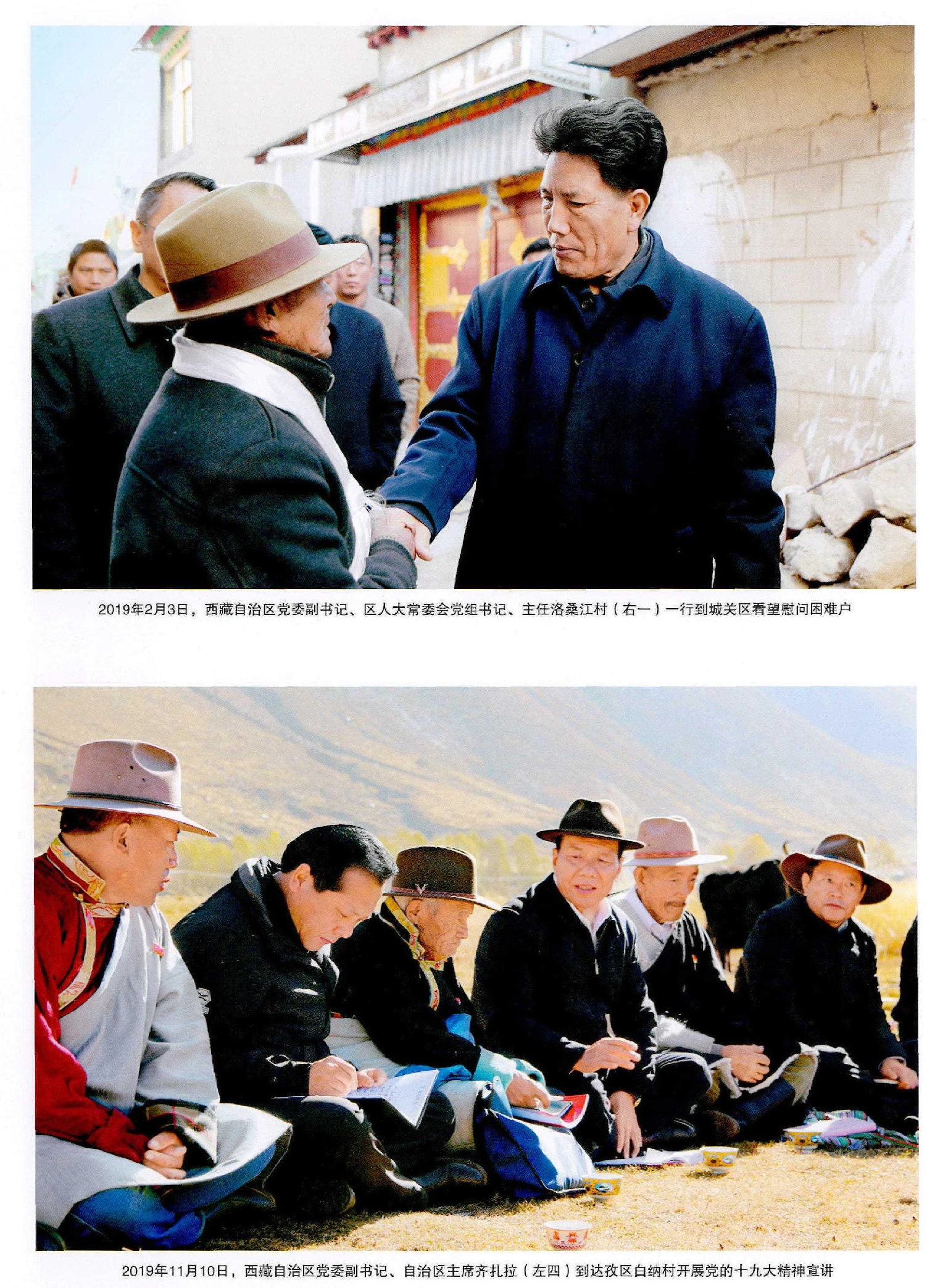
Lhasa has launched a construction blitz, a classic campaign-style mobilization 运动式治理 all hands on deck to accelerate Tibet’s trajectory into modernity with Chinese characteristics.
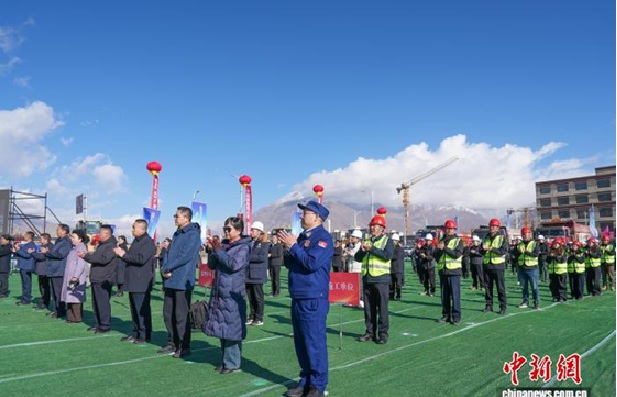
At Lhasa’s new giant data crunching centre, Lhasa’s Chinese mayor Wang Qiang told lined up cadres, March 2026, their campaign is “treating the start as a decisive battle and the beginning as a sprint, seizing the policy window and the golden period for project construction.” Over 1000 nation-state building projects launched on a single day. Americans call this shock and awe. Tibetans are required to perform gratitude for this outpouring of accelerant by statist enterprise. http://tibet.cn/cn/in/xzxw/202603/t20260317_7947180.html
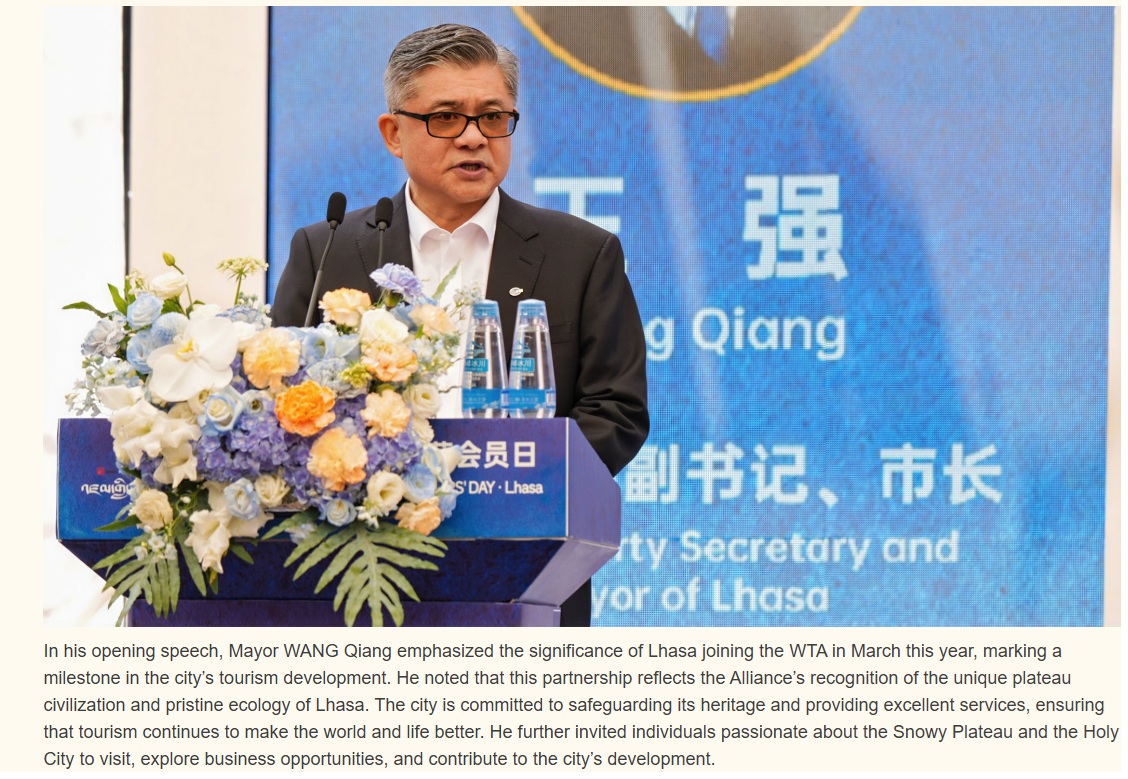
Addressing assembled cadres and construction workers all standing stiffly to attention, Lhasa’s Chinese mayor “emphasised that all responsible units must adopt a proactive attitude of “treating the start as a decisive battle and the beginning as a sprint, seizing the policy window and the golden period for project construction. They should work backwards from deadlines and implement a visual management approach to ensure the ‘three rates advance in tandem’ – project implementation rate, commencement rate and investment rate – whilst achieving a ‘threefold increase’ in work volume, physical output and investment volume; They must proactively provide frontline services, streamline approval procedures, and foster an efficient and convenient environment for government services; they must adhere to high-standard planning, high-quality construction and high-level management, strictly controlling quality, safety and integrity, so that every project is truly transformed into a model project, a demonstration project and a safe project that stands the test of both the people and history.”
The campaign style mobilisation is the last remnant of a once revolutionary party’s tactics for surging forward to overwhelm the enemy. At a time when the ruling CCP abhors the slightest hint of revolution brewing, why this resort to a tactic as old as the Party? Classic CCP campaign to overcome intractable problems such as Tibetans preferring to be Tibetan.
Chinese political scientists tell us: “The ‘campaign-style enforcement’ is a forceful policy instrument employed by Chinese authorities to address emergencies and intractable issues. Campaign style enforcement (CSE) The CSE has been scholarly used to describe top-down policy implementation for addressing significant emergencies and societal crises by extensive mobilization of governments at all levels in China. It is considered an effective tool to ensure regulatory compliance and resolve conflicts between efficiency and legitimacy.”[1]
Probably Donald Trump and Elon Musk have never heard of campaign-style mobilization 运动式治理 , but they do know a lot about forceful policy instruments to overcome intractable issues. Yet their agenda is to strip the state of power, China’s is to extend and reinforce state power into the remotest landscapes.

URGENT URBAN MODERNITY
What is the urgency that requires the staging of a media event that launches 1036 central Tibet projects all at once, since the implementation period is the just-launched Five Year Plan? Forcefulness overcomes intractable problems. The triumph of the human will, mobilised to act in unison, can conquer nature, conquer all, reminiscent of the Great Leap Forward mobilisations of the 1950s. What is the emergency? Where is the societal crisis?
Tibet is China’s wicked, intractable problem. In a world in turmoil, Tibet must be secured, a buffer against all that threatens from the west, and the West. The Himalaya and a vast plateau island in the sky protect lowland China from any threat from India. But the greatest threat, Xi Jinping says repeatedly, is Westernisation, and that requires buffering the buffers.
The paradox is that while Lhasa is now required to grow fast economically, and employ many Han emigrating from the lowlands, at the same time China continues to tightly restrict Tibetans entering Lhasa, for fear of enabling Tibetan crowds to mobilise protests. At a time when rural Tibet is being steadily depopulated, by coercive displacement of farmers and pastoralists from their lands, resettling the displaced in Lhasa is forbidden.
The displacement of rural Tibetans while also constricting growth of Tibetan population in Lhasa offers a clue as to what some of those 1036 projects intend to achieve, elsewhere.
Lhasa will grow, attracting sojourning Han, attracted by the high wages and job security of centrally financed projects, the West Compute build being the headliner. Lhasa may eventually catch up to what by now is by far the biggest city of the Tibetan Plateau, Xining, far to the northeast of Lhasa, and almost wholly Chinese city in which a small Tibetan population is grudgingly tolerated.
“From 2000 to 2020, the city’s population burgeoned from 958,900 to 1,559,800 inhabitants, marking a staggering increase of 609,900individuals, equating to a growth rate of 62.67%. Simultaneously, the city’s Gross Domestic Product (GDP) surged from 10.174billion in 2000 to137.298 billion in 2020, reflecting a remarkable growth rate of 1249%. As the largest city on the Tibetan Plateau, Xining serves as the northern gateway to Tibet.”[2]
ALIEN RULE
This is the long tail of empire, of Manchu Qing armies conquering the Dzungar Mongols in what then became the New Land, Xinjiang, three centuries ago. Alien rule. Centuries later Beijing and its endless ideological sloganeering still feels far away, and the unitary nation-state China demands remains incomplete.
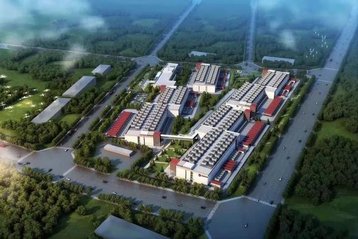
Security and development have fused as the solution. Nation building may be abhorred by Trump’s American but is central to transitioning Tibet and Xinjiang away from the last vestiges of “autonomy” and in to the Zhonghua Han Chinese race. Hence the 1036 Lhasa projects launched at the icon of high modernity with Chinese characteristics, the construction site of China Telecom’s Second Hub and Green Intelligent Computing Centre in the Lhasa Economic and Technological Development Zone.
This makes Tibet both buffer and backroom, the coolest computing centre in China.
However “Green Intelligent Computing” is just the headliner of a program of compulsory Sinicization, 1036 Lhasa based projects, in which security defines development. What else is on that list of 1036?
China is now in a hurry to fully assimilate Tibet, and has utterly lost patience with Tibetan stubbornness, ingratitude, love of Tibetan culture, language and civilisation. Securitised development projects can be sold as China’s great developmentalist gift to Tibet, herding Tibet into mandatory modernity materialism, wealth accumulation, individualism, prosperity.
These projects intend to finally end three centuries of alien rule by making the Tibetans Chinese; in a forced march into high consumerist modernity that in daily reality further alienates Tibetans. China not only repeats past mistakes but amplifies and accelerates them.
Tibetans are to be overwhelmed by the pace of accelerated induction into modernity, seizing the policy window of this golden period of construction, as Lhasa’s mayor calls it. That is the point of campaign style mobilisation, to accelerate the pace, simplify the narrative, sweep aside all opposition, thus triumph. Elon Musk and Donald Trump know how this works.
A NEW FRONT OF NATIONAL POWER
Full circle, to earlier campaign style mobilisations, when campaign and mobilisation were both directly military language. At the same time as the disastrous 1958 Great Leap Forward Mao’s China also initiated its Third Front crash program of atom bomb and submarine construction, to desperately catch up with both the capitalist American enemy and the revisionist Soviet enemy.
Tibet and Xinjiang were at the forefront of the Third Front campaign; Xinjiang for exploding the first nuclear weapons, Tibet’s “Atomic City” on the shores of Tso Ngonpo/Qinghai Hu/Koko Nor, where submarines and their missiles were designed and tested.[3]
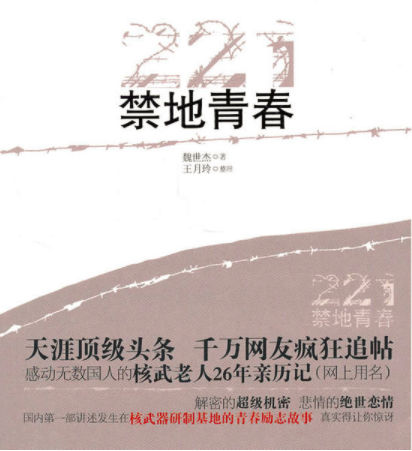
In China’s west, fifteen million people were mobilised in that urgent campaign to become a nuclear threat.
The best known of the Tibetan red tourism destinations is not in central Tibet but in Amdo/Qinghai, on the lake shore, officially badged “Atomic City 原子之城”. Formally it was Qinghai 221 Plant, the nuclear weapons research and development base of the Ninth Research and Design Institute of the Second Ministry of Machine Building Industry.
Oddly for a mass tourism destination Chinese citizens are welcome to make the pilgrimage, as they inherit the red gene; yet foreigners are not permitted entry, rather lacking in red genes. However, an online tour is available, thanks to Xinhua and the prefectural TV station.
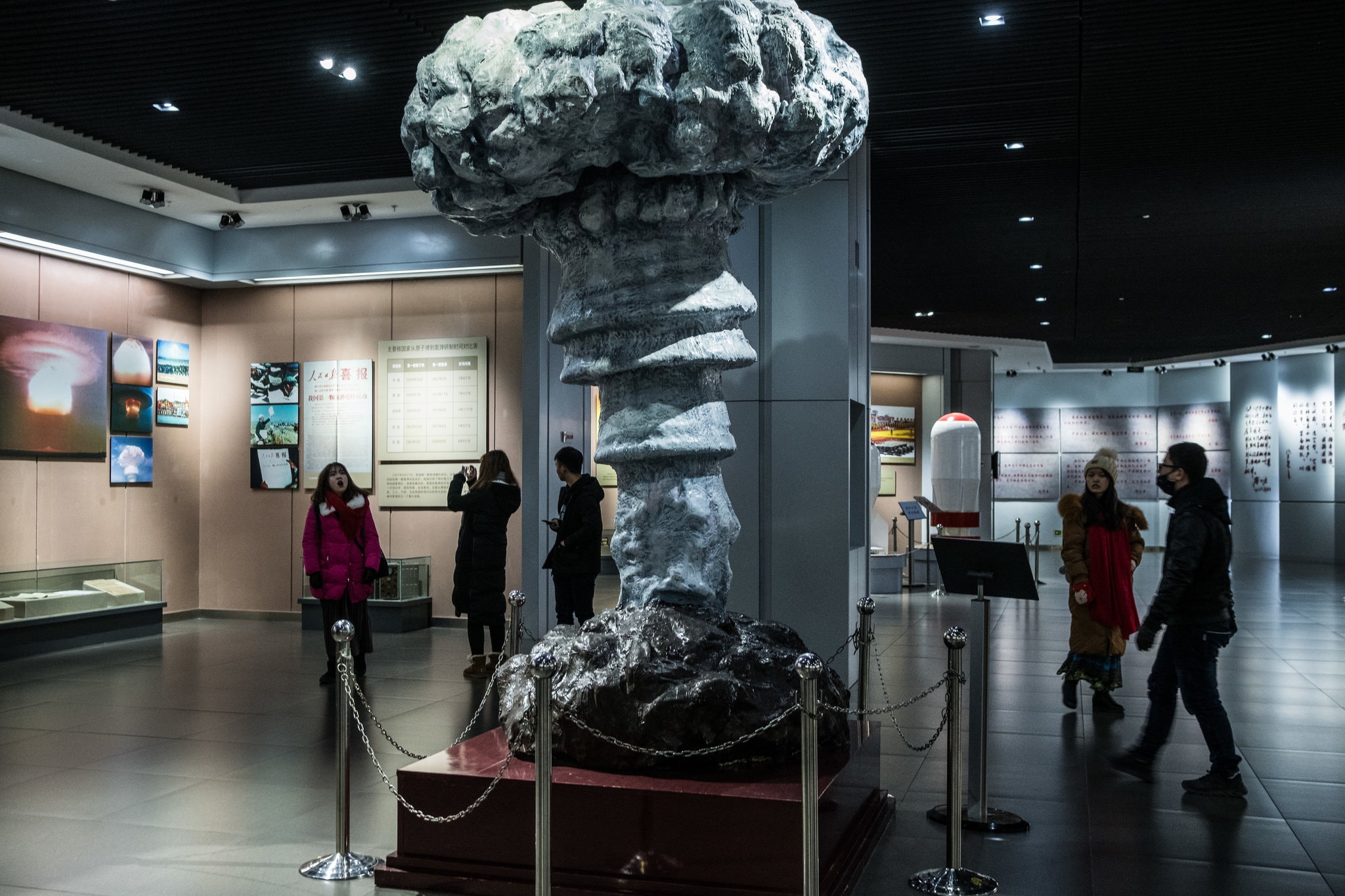
The strapline of this museum is “Two Bombs and One Satellite Spirit” “两颗原子弹和一个卫星幽灵”, celebrating China’s entry into global contention by first building and exploding a nuclear fission bomb in 1964, a hydrogen fusion bomb in 1967, and launched its first satellite into orbit in 1970.
These days China is rapidly upscaling its nuclear arsenal, including a new hydrogen bomb so extremely hot it was never imagined in existing nuclear treaties. So there is plenty of demand for red gene destinations among a new generation of would-be wolf warriors.
New York Times in 2018 showed us inside Atomic City. But was rather queasy: “Among the yak herds and Tibetan Buddhism prayer flags dotting the windswept highlands of northwestern China stand the ruins of a remote, hidden city that vanished from the maps in 1958. The decaying clusters of workshops, bunkers and dormitories are remnants of Plant 221, also known as China’s Los Alamos. Here, on a mountain-high grassland called Jinyintan in Qinghai Province, thousands of Tibetan and Mongolian herders were expelled to create a secret town where a nuclear arsenal was built to defend Mao Zedong’s revolution. ‘It was totally secret, you needed an entry pass,’ said Pengcuo Zhuoma, [Phuntsok Drolma] 56, a ruddy-faced ethnic Mongolian herder living next to an abandoned nuclear workshop, whose family once supplied meat and milk to the scientists. ‘Your mouth was clamped shut so you couldn’t talk about it.’”
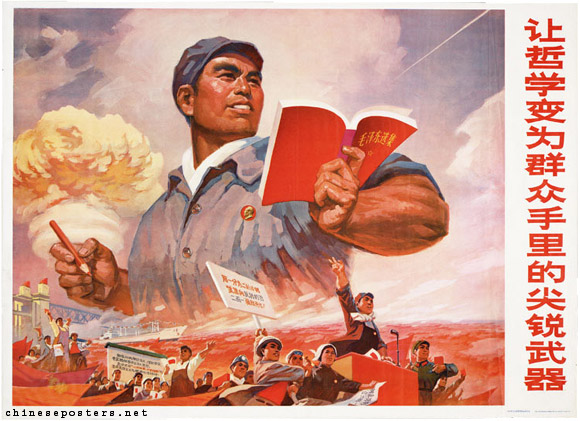
Now campaign style onrush acceleration, driven and financed not by partner provinces but direct from Beijing, is accelerating further, with the massive Yarlung Tsangpo hydro project as its core.
The announced budget of the mega hydro project is seven times the Lhasa 1036 project package, sufficient to drive the whole of central Tibet into China’s grasp as never before. Add in a huge outlay on solar, wind power and power grids, largely in Chamdo, the total capital expenditure is capable of locking Tibet into China; and almost all the plans, the finance and control are direct from Beijing, a nationalisation of central Tibet.
It wasn’t always thus. For decades China’s reach into central Tibet exceeded its grasp. In 1984 China proudly announced 43 development projects to be built in Tibet; Wikipedia lists them all. A further 62 development projects were announced in 1994, again listed online. Back in the day these modest projects, mostly financed and overseen by compulsory contributions from richer provinces, were reason to boast of China’s benevolence.
Security always came first, development secondary. Gradually they fused. Development was securitised, every project must advance the security of a frontier buffer that must become wholly Chinese.
The announced capital cost of these 1036 projects is RMB 170 billion, roughly USD 24.6 billion, an order of magnitude greater than past decades of pairing-up assistance for Tibet, 对口援藏.
Unlike the 43 listed projects of TAR development in 1984, or the 62 of 1994, we don’t have a list of the 1036 construction projects now officially “sprinting”. We do know the big headliners, such as the West Compute build. We know that the Yarlung Tsangpo hydro project, costing seven times the package of Lhasa based projects, is administratively separate, directly answerable to Beijing.
We also know that several of the 1036 are designed to turn the long north face of the Himalaya into a belt of red tourism destinations, encouraging patriotic Han to tour the long line of frontier villages and military garrisons where occupying troops and displaced rural Tibetans live in harmony, sharing the burden of guarding China’s long border with India.
The TAR 15th Five Year Plan issued in February 2026 explicitly fuses the villagisation of displaced farmers and nomads, with the military patrolling of the border, and commercialises it all as a new destination for patriotic red tourism: “Construct a border characteristic industrial belt integrating border ports, agricultural and pastoral production areas, industrial parks, and tourist attractions to enhance the self-development capabilities of border areas. Actively construct the Purang Border Tourism Experimental Zone, plan and develop tourism routes such as patriotic border defense tours and mountain trekking tours, and enrich the supply of border tourism and cross-border tourism products. Improve the mechanism for joint border defense by the Party, government, military, police, and civilians to ensure border security and stability. 完善党政军警民合力强边固防机制,确保边防巩固、边境安全”
Purang is in the far west of upper Tibet, gateway to the Kailash pilgrimage. The highway and eventual railway all the way from Lhasa to Purang and beyond are officially launched, although the railway construction will take a decade. The entire north face of the Himalaya, roughly 2000 kilometres, is fast becoming an archipelago of villagized, demobilised Tibetan former farmers and pastoralists. Planting them along the border with India means planting China’s flag in even the most sparsely populated rain shadow districts, and trade follows the flag. The red tourists will come, if there is a good highway, and good hotels. The red tourists will see villagized Tibetans heading out on border patrols, an essential role since Han Chinese soldiers puff and pant hypoxically at border patrol altitudes, while the mitochondrially adapted Tibetans still have kinetic energy.
https://mp.weixin.qq.com/s/KPwqiIEvSGMtoOyAiVECfg
[1] Xingyu Qian and Yangguang Yao, Sword of Damocles hanging over grassroots cadres in China: Understanding the accountability in campaign style enforcement, International Sociology, 2024, Vol. 39(4) 422–444
Jiang W and Qian X (2022) Fragmented property rights and residents’ participation in renovation of old communities: Comparative case studies in Haikou. Lex Localis –Journal of Local Self-Government 20(1): 259–277.
Zhou X (2014) China’s national governance and its model: A holistic perspective. Academic Monthly 46(10): 5–11
Zhou X (2017) The Institutional Logic of Governance in China: An Organizational Approach. Beijing, China: SDX-Joint Publishing Company
Tang H (2007) Normal society and campaign-style enforcement governance: A study of the policy on severely fighting in China’s social security governance. Open Times 3: 115–129
Feng S (2011) Formation and variation of China’s national movement: Based on the holistic interpretation of the political system. Open Times 1: 73–97
[2] : Zhi, Z.; Liu, F.; Chen, Q.; Zhou, Q.; Ma, W. Study on the Urban Expansion of Typical Tibetan Plateau Valley Cities and Changes in Their Ecological Service Value: A Case Study of Xining, China. Sustainability 2024, 16, 4537. https://doi.org/ 10.3390/su16114537
Pan, X.;Wang, Y.; Liu, Z.; Understanding Urban Expansion on the Tibetan Plateau over the Past Half Century Based on Remote Sensing: The Case of Xining City, China. Remote Sensing. 2021, 13, 46. https://doi.org/10.3390/rs13010046
[3] Covell F. Meyskens, Mao’s Third Front: The Militarization of Cold War China, Cambridge U Press, 2020
Xu Youwei (2020) Exploring New Frontiers in Contemporary Chinese History Studies: A Case Study of Third Front Construction, Social Sciences in China, 41:2, 164-182, DOI:10.1080/02529203.2020.1766255
John Wilson Lewis, Xue Litai, China Builds The Bomb, Stanford U Press, 1991
This post by Gabriel Lafiite, with assistance from Shede Dawa at Tibet Watch