I got it wrong. I saw no sign China was going ahead with its Yarlung Tsangpo mega hydro build until too late.
Turns out I was looking in all the wrong places for signs: China’s many hydropower research journals, official decrees, scientific expedition reports, engineering journals on ingenious ways of mitigating the innumerable hazards of drilling tunnels through the most earthquake prone zone.

The polite term for my failure is path dependency, in plain words: habit. Habitual assumptions that the mesmerizing, magical number of kilowatt hours electricity output theoretically generated by damming the lower Yarlung Tsangpo just before it exits Tibet into India, could not be made reality. Risks were just too great. Distance from China’s big electricity consuming cities and factories too far. Too colossal a project, too expensive, too seasonally uneven to provide year-round hydropower.
All good, reasonable assumptions for why a project imagined back in the 1970s by hydro engineers peering covetously into the deepest canyon in the world, but had long been shelved, as undoable.
Reasonable as those assumptions were, and maybe still are, I was wrong. On Christmas Day 2024 China announced the “dam” had been approved, one year before the 14th Five Year Plan ended.

How I got it so wrong is worth exploring, with help from a recent analysis on how the experts on China’s geostrategic thrust got so wrong about China’s drive to massively expand its nuclear weapons production. A comparable case of experts making reasonable assumptions that were wrong. https://horsdoeuvresofbattle.substack.com/p/siloed-silos-and-analytical-failures Decker Eveleth writes: “due to what I view as continued adherence to dubious analytical approaches, scholars examining China continue to repeat many of the mistakes that led to this failure. All told, there were 320 new missile silos under construction. All this information was then confirmed by STRATCOM and is now included in the Pentagon’s annual China Military Power rfeport.
“This discovery completely blindsided the China-watching community. The discovery was met with intense scepticism from China-watchers. Jeffrey and I were presented with a cavalcade of alternative explanations for what these could be. What was equally remarkable was the reaction from Chinese media. Soon after our discovery, several of the more prominent Western pro-China accounts began claiming that the silo fields were actually windfarms. This was because there was indeed a windfarm. The windfarm story became, via completely organic means, the dominant Chinese cover story and was immediately picked up by the Global Times, the Chinese ‘Ministry of Foreign Affairs, and basically every Chinese Embassy. This story, including the Chinese cover story about the windfarms, has several analytical lessons that have still evaded many China watchers. How did much of a country-watching community get a state’s strategic intent so wrong? Area specialists are commonly blindsided by discontinuous changes in policy of the state they are examining. This is due to: the cry wolf phenomenon, base rate capture, and paradigm lock-in. Paradigm lock-in is an especially large problem in academia, and in the Chinese case the idea that Chinese nuclear restraint was a core feature of “Chinese nuclear thought” became effectively unchallenged in some China circles.”
Not only did I not see the megaproject coming, I had never heard of paradigm lock-in, but it fits. I had read and filed hundreds of research reports quantifying the multiple risks of quakes, glacier collapses, massive floods and other dangers, and decided the long list of uncontrollable dangers was just getting longer: explosive rock bursts inside tunnels, boiling hot water forcing its way up, a syntaxis pivot which tears mountains and canyons in two directions at once, both northward and eastward.
What I almost completely ignored was the steady westward and upriver march of China’s dam builders, the Yarlung Tsangpo the furthest west. I worried that construction of extraordinarily high walled dams was moving further up river into Tibet, on other major rivers, but the Yarlung Tsangpo is almost everywhere in Tibet broad with low banks, not the narrow high walled chokepoints dam designers look for; with the exception of the Great Bend grand canyon, just too deep, the river too wild, to ever be dammed.
My biggest fail was to not connect the dots linking China’s 15th Five Year Plan -2026 to 2030- emphasis on intensifying industrialisation, especially electricity hungry data centres, with the Yarlung Tsangpo as the solution to accelerating demand for boundless cheap electricity. I did see the campaign to carpet Tibet with wind turbines and solar arrays on staggering scale, surrounding each hydro dam and long-distance electricity transmission grid, but I still didn’t foresee the Yarlung Tsangpo megaproject as central to this green energy combo.
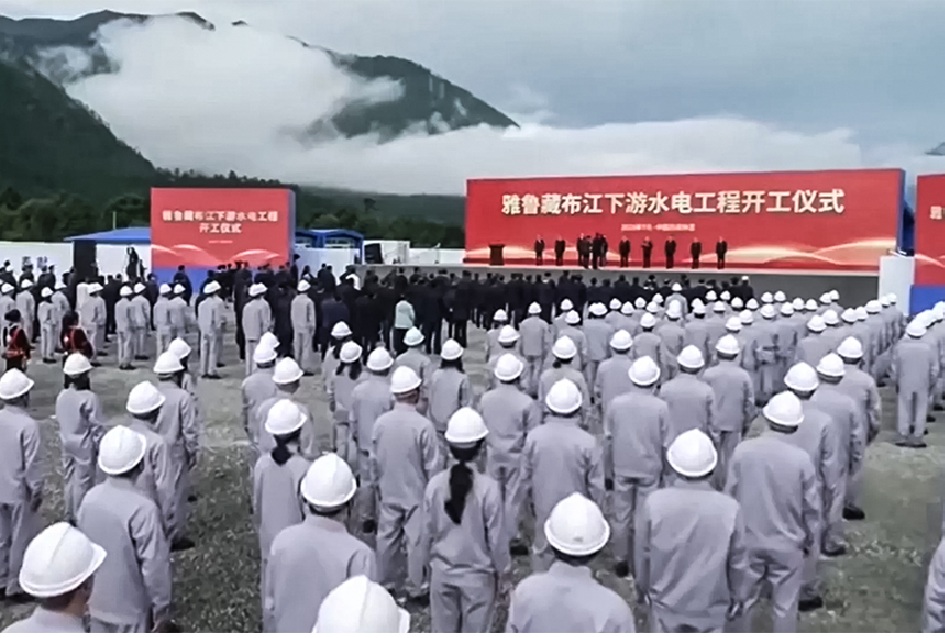
Although the go-ahead was announced in the 14th Five-Year Plan, the actual build, starting 2027, may well take a decade, which will be the 17th Plan period. I saw how America’s high-tech billionaires race around for urgent access to much more electricity, to beat China to global dominance in data and the AI that is fed by data crunching. So urgent they are demanding the US rebuild power grids while the billionaires demand a quick build of gas fired power stations, nuclear power, geothermal, any and all the above. If it’s that urgent, I figured, a Yarlung Tsangpo project where the turbines don’t start whirring till 2035 or later just doesn’t cut it.
Wrong again. Yarlung is go. All the more so because the Chengdu to Lhasa high speed railway runs right alongside major tributaries of the Yarlung Tsangpo, then beside the main river, for hundreds of kilometres, with lots of tunnelling, the same kind of tunnel boring machines that will divert the Yarlung Tsangpo into tunnels and turbines. That double track, electrified rail line is due for completion in 2030, its many tunnels an engineering experiment directly relevant to the hydro big build.
There remains one more of my lockjaw paradigm lock-ins that even now I can’t see was wrong. The biggest argument against this extraordinarily expensive mega project is that the much touted maximum electricity output happens only half the year, at most, even if seasonal river flow is extended by an elaborate system of dams designed to hold back the summer monsoon peak flow long enough to extend the rainy season stream flow well into autumn. Indeed, that is exactly what is now planned, but still I wonder if an upriver barrage near Nyingtri will suffice. Or is that where all those solar and wind installations kick in, providing year-round reliable green energy? In the winter dry season there is plenty of sunshine, and often strong wind. Or is the megaproject going to disappoint? Climate change adds to the uncertainty.
Clearly, this is something China’s central planners have considered. On the eve of Donald Trump’s arrival in Beijing in May 2026 the central planners of the National Development and Reform Commission, National Energy Administration, Ministry of Industry and Information Technology, and National Data Bureau jointly issued their trump card: the “Action Plan for Promoting Two-Way Empowerment Between Artificial Intelligence and Energy” 关于促进人工智能与能源双向赋能的行动方案. While the Americans flail, China has it all worked out. The Yarlung Tsangpo megaproject is their magic weapon (法宝). For every problem, there is an engineering solution: that is the mantra of the party-state.

The decree puts AI electricity demand front and centre of it’s nation-building case for statist intervention: “strengthen the foundational supporting role of energy for AI development, leverage the superimposed multiplier effect of AI on the energy transition, promote two-way empowerment between AI and energy development, and accelerate the construction of a new “AI+” energy development landscape that is coordinated, efficient, secure, reliable, green, low-carbon, open, and integrated—this action plan is hereby formulated.”
China presents itself as capable of planning, engineering and constructing its solution to any and all problems, while the US of A flails, fails to figure out who, where, what is to be done to rapidly raise electricity supply to meet demand.[1] Yet again China achieves several core goals, at once. By carpeting all productive landscapes of Tibet in hydro, wind and solar installations, it colonises Tibet as never before. By boasting of its dominance in green energy tech China wins global admiration for solving the climate crises, while the global audience ignores China’s ongoing addiction to coal fired power. By urgently accelerating the hydrofication/ solarisation of Tibet, China reduces dependence on Mideast oil and the shock of a war that -as China told Trump- should never have happened.
This is more than win-win. Yarlung Tsangpo will exempt China from reliance on Iranian and Gulf oil, gas, urea fertiliser, plastics precursors and more. I certainly didn’t see that coming. This is China’s win-win-win, even if the dam at the heart takes time, the grids, solar and wind are now being installed at astounding pace.
“Xi Jinping has elevated Chinese industrial policy into something the world has never seen. It targets almost every industry and region, demand as well as supply, services as well as goods, the sophisticated and the mundane. Its goals are economic, technological and strategic. Its tools are microeconomic and macroeconomic. National security is integral to Xi’s industrial policy. Eliminating imports makes China less vulnerable to foreign pressure, while increasing export market share makes others more vulnerable to Chinese pressure.”
China presents itself as stable, reliable, rational, capable of solving not only its own supply and demand problems but engineering solutions for all nation-states. Intensified colonisation of the Tibetan Plateau is core. Tibet as extraction zone, exporting electricity, minerals, water, climate to China means Tibet is no longer an afterthought, a peripheral nuisance.

The latest policy diktat assigns to Tibet prime location: “By 2030, the clean energy supply security capacity for AI computing power facilities, as well as the R&D and application of AI-specific technologies in the energy field, will reach world-leading levels, and the two-way empowerment between AI and energy will achieve significant results. We will give full play to China’s advantages of a complete energy industry system, abundant data resources, and broad application scenarios; promote efficient coordination of energy, computing power, scenarios, data, models, and other elements; help seize the commanding heights of AI industrial application; and strongly support high-quality energy development.”
China’s global dominance of manufacturing, “the world’s most complete industrial system” is, in this 15th Five Year Plan augmented by a new mass mobilisation campaign for dominance of all emerging industries, especially AI. Not only is Tibet to be the main source of electricity essential to fulfilling this new target, Tibet is also to become China’s computing backroom, under the “east data, west compute” policy. One of the high voltage grids radiating out from the lower Yarlung Tsangpo heads to Lhasa, to keep big data crunching centres supplied. I didn’t see that coming either.
In the fine print of this latest decree, China will also turn to nuclear power more than ever, and also more coal, but be assured new coal mines will also be high tech: “intelligent decision-making for open-pit mine production and coordinated operation of intelligent mining, hauling, and dumping equipment; condition monitoring and predictive maintenance of coal mine equipment; rapid coal quality testing and intelligent optimization of washing processes; intelligent early warning and prevention/control of coal mining safety; intelligent monitoring and regulation of ecology and environmental protection in coal mining areas.”

But longer term it is the hydro/solar/wind combination that is the future, plus hydrogen as a non-carbon fuel, which also will come from Tibet. That means separating H2O water into hydrogen and oxygen, then capturing the hydrogen and pumping it, in pipelines to where it will be burned. Why Tibet? This is where pumped hydro comes in, small dams just below the big ones, that regulate the 24/7 cycle of distant demand by deploying the turbines, in off-peak demand hours, to pump water back up to the big dam ready for the next peak hour, and/or use hydroelectricity to split water into hydrogen and oxygen.

The tech to accomplish this already exists, but not yet at scalable, profitable levels, but it is coming. Extraction intensifies further. Tibet’s endowment of water, sun, wind, minerals is being siphoned.
All this adds up to a magic weapon (法宝) of many dimensions, many uses; a gift that keeps giving. Intensified colonisation of Tibet is offscreen, largely invisible. What is visible, and loved by environmentalists and climate campaigners is that China is the world’s exemplary electrostate, while USA goes backwards into fossil fuel dependence more than ever. Didn’t quite see how big that contrast was going to be.
China decrees AI, data centres and hydropower interdependent, but not equal. In order to maximise global AI dominance, it is official policy that electricity prices must be cheap. Tibet will not benefit from all the dams, solar arrays and wind farms; no royalties are paid, compensation for land loss is minimal, Tibetan farmers and pastoralists are routinely evicted and shunted into new frontier villages far away.
The May 2026 central planners decree is just one of several, all of which make AI “stand out as a special case because it has been elevated above other future industries to the status of a cross-cutting, foundational technology. The term appears four times in the 13th FYP, six times in the 14th FYP, and 52 times in the 15th FYP. At the local level, the number of policies with AI in their title has surged from two in 2016 to 235 in 2024 and 584 in 2025. Rather than treating it simply as a technology to develop, the 15th FYP frames it as an infrastructure-like technology, underpinning entire industrial ecosystems. The goal is to use AI to achieve all the other objectives of China’s industrial policy: upgrading mature industries, addressing chokepoints in emerging industries, developing services, and accelerating productivity growth.”
Industries China plans to dominate:
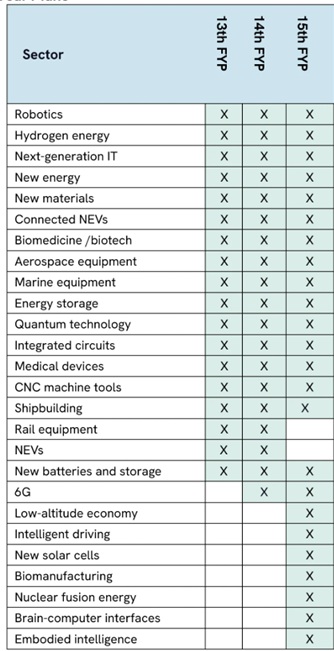
Source: Rhodium Group 2026
WHEN DOESTHE BIG BUILD BEGIN?
I have taken time to reflect on what I got wrong, but time is running out. Since China’s big reveal late 2024, there has been little to see on the ground, on the Yarlung Tsangpo in the actual river, after a 2025 flurry of corporate launches that guarantee state funding.
However, it now looks like 2027 will be the year construction work begins, beyond the recent construction of worker dormitories.
Now is the time for in-depth analysis to also begin work, especially on the well-known unknowns of Yarlung Tsangpo climate change, huge differences in measured monsoon peak streamflow and winter dry season, and whether AI, engineering, algorithms and formulae suffice to make that mega project fulfil the hype.
Here is a taste of the realities we, and China’s central planners are alike wrestling with: seasonal streamflow in the Yarlung Tsangpo, at the Nuxia gauging station very close to where the river is to be diverted into headrace tunnels and turbines, bottom line on this chart.
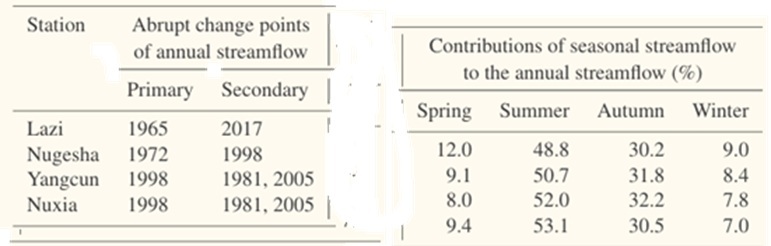
This 2025 calculation defines 83.6 per cent of Yarlung Tsangpo streamflow to be in the summer and autumn, with only the remaining 16.4% in the six winer and spring months.
So how can this massive hydroproject reliably deliver year-round, 24/7/365?
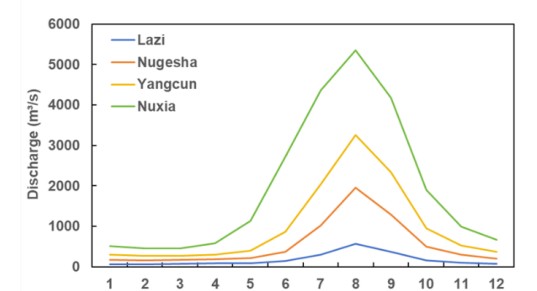
This sharp contrast between wet and dry months raises serious questions, sharpened further by climate change projections in this 2025 research report. How likely is it that the yarlun g Tsangpo project will be a massive fail? Can surrounding the hydro with solar, wind, pumped hydro and hydrogen extraction make up the shortfall winer and spring seasons? Conversely, how likely is it that in peak streamflow months, much of what is generated by Yarlung Tsangpo tunnel turbines goes to waste? What is politely known as curtailment, or electricity abandonment, has long been a major problem Beijing has never solved, due to resistance by wealthy provinces that preferences electricity supply from coal fired power stations they own and run. Will curtailment/abandonment only worsen?
These and many other risks will be explored in coming Rukor posts, and a chapter in the forthcoming Routledge title: Tibet’s Climate Crisis: Power, Politics and China’s Environmental Statecraft. There is also the Dharamsala Tibet Museum’s Rivers of the Sky online interactive, text by Rukor editor Gabriel Lafitte https://d3rtf2y9gc3jto.cloudfront.net/Brahmaputra/Brahmaputra.html
[1] Dan Wang, Breakneck: China’s Quest to Engineer the Future, 2025